You receive a WhatsApp message from a familiar name. The person claims to be in trouble and urgently needs money. Without thinking too much, you consider helping.
Later, you realize something feels wrong.
This situation has become common across Nigeria. Many people fall victim to WhatsApp scams not because they are careless, but because scammers understand how to create urgency and trust.
So the real questions are:
- How can I avoid WhatsApp scams in Nigeria?
- How do I know if a message is genuine or fake?
- What should I do if I’m targeted?
Most people simply want a safe, practical way to use WhatsApp without losing money or personal data.
This guide explains how WhatsApp scams work, how to detect them early, and how to protect yourself and your loved ones.
What Are WhatsApp Scams?
WhatsApp scams Nigeria refers to fraudulent messages or activities designed to trick users into giving away money, personal details, or account access.
These scams rely more on psychology than technology.
In Nigeria, the risk is higher because:
- Mobile banking is widely used
- Instant transfers are common
- WhatsApp is one of the most popular communication platforms
A scammer does not need to hack your phone. In most cases, they simply convince you to act quickly without thinking.
Also read: How to Avoid Getting Scammed on Instagram in Nigeria
Key Insight:
WhatsApp scams succeed because of human reactions, not technical weaknesses.
Common Types of WhatsApp Scams in Nigeria
Understanding the different forms of scams is the first step in avoiding them.
A. Impersonation Scams
- Scammer pretends to be your friend or family member
- Claims they have an urgent problem
- Requests money immediately
Example:
A student receives a message from a “coursemate” asking for urgent school fees assistance.
B. Investment and “Double Your Money” Scams
- Fake crypto or forex offers
- Promises of quick returns
- Requires initial deposit
These scams often target young Nigerians looking for quick income.
C. Job and Scholarship Scams
- Fake job offers or scholarship opportunities
- Requests for “processing” or “registration” fees
Example:
A WAEC graduate receives a “foreign scholarship” offer that requires payment before processing.
D. WhatsApp Account Hacking Scams
- Scammer asks for a verification code
- Gains access to your account
- Uses your account to scam others
E. Fake Promotions and Giveaways
- “You have won a prize” messages
- Includes suspicious links
- Requests personal details
Key Insight:
If a message creates pressure or urgency, it is often a scam.
How to Avoid WhatsApp Scams in Nigeria
This is the most important section.
Practical WhatsApp Fraud Prevention Steps
1. Verify Before You Trust
- Call the person directly
- Confirm through another platform
2. Never Share Verification Codes
- WhatsApp codes are private
- No legitimate person will ask for them
3. Avoid Clicking Suspicious Links
- Check the link carefully
- Avoid shortened or strange URLs
4. Enable Two-Step Verification
- Adds an extra layer of protection
- Prevents unauthorized access
5. Be Careful with Unknown Numbers
- Do not respond immediately
- Observe the message carefully
6. Avoid Urgent Financial Requests
- Scammers rely on panic
- Always pause before sending money
Key Takeaway:
The safest users are not the smartest, but the most careful.
5. How to Identify a WhatsApp Scam Message
Many people ask: How do I know if a WhatsApp message is a scam?
Watch for these signs:
- Poor grammar or unusual tone
- Sudden urgency (“send now,” “I’m stranded”)
- Requests for money or codes
- Suspicious links
- Unknown or newly created numbers
Example:
A message saying “I need help urgently, send now” without clear explanation is a red flag.
Also read: How to Track a Fraudster in Nigeria (Realistic Guide)
Key Insight:
If a message feels rushed or confusing, pause and verify.
Can WhatsApp Scammers Hack Your Account?
A common fear is: Can WhatsApp scammers hack my account?
The answer is yes, but not in the way most people think.
Scammers usually gain access through:
- Social engineering
- Verification code tricks
They cannot hack your account simply by sending a message.
Important Note:
You give access when you share sensitive information.
What to Do If You Are Targeted by a WhatsApp Scam
If you suspect a scam:
Immediate Actions
- Stop responding
- Block the number
- Report the contact on WhatsApp
- Inform your contacts
If Money Is Involved
- Contact your bank immediately
- Request transaction review
- Report to authorities
Key Takeaway:
Quick action can reduce damage.
How to Report WhatsApp Scams in Nigeria
Reporting helps protect others.
Where to Report
- Your bank
- Law enforcement agencies
- WhatsApp support
Steps to Follow
- Save all evidence (screenshots, chats)
- Submit a complaint
- Follow up regularly
Key Insight:
Proper reporting increases the chances of investigation.
Real-Life Scam Scenarios (Nigeria)
Case 1: Impersonation Scam
A student receives a message from a “friend” asking for urgent help.
Money is sent immediately.
Later, the student discovers the friend’s account was hacked.
Case 2: Smart User
Same situation.
The student calls the friend first.
The friend denies sending the message.
No money is lost.
Lesson:
Verification saves money.
Common Mistakes People Make
- Acting too quickly
- Trusting familiar names without confirmation
- Ignoring warning signs
- Sharing personal information
Insight:
Scammers depend on speed and emotion.
WhatsApp Security Tips for Nigerian Users
To stay safe on WhatsApp:
- Enable two-step verification
- Use fingerprint or PIN lock
- Update your app regularly
- Avoid public Wi-Fi for sensitive chats
- Check linked devices
How to Protect Family and Friends
Many victims are not aware of these scams.
You can help by:
- Educating older relatives
- Sharing safety tips
- Encouraging verification habits
Key Insight:
Awareness reduces risk.
Quick Checklist: How to Avoid WhatsApp Scams in Nigeria
✔ Verify every urgent request
✔ Never share codes
✔ Avoid suspicious links
✔ Enable security features
✔ Report suspicious messages
❌ Do not:
- Send money without confirmation
- Trust unknown numbers
- Click random links
FAQs
How can I avoid WhatsApp scams in Nigeria?
Verify messages, avoid sharing sensitive information, and enable security features.
What are common WhatsApp scams in Nigeria?
Impersonation, fake investments, job scams, and account hacking.
How do I know if a WhatsApp message is a scam?
Look for urgency, suspicious links, and unusual requests.
What should I do if I get scammed on WhatsApp?
Report immediately, contact your bank, and secure your account.
Can WhatsApp scammers hack my account?
Yes, mainly through social engineering and verification code scams.
Can WhatsApp scams happen without clicking links?
Yes. Many scams rely on convincing messages rather than links.
Should I reply to suspicious WhatsApp messages?
No. It is safer to ignore and verify through another channel.
Is blocking a scammer enough?
Blocking helps, but reporting is also important.
Can scammers access my contacts?
Only if they gain control of your account.
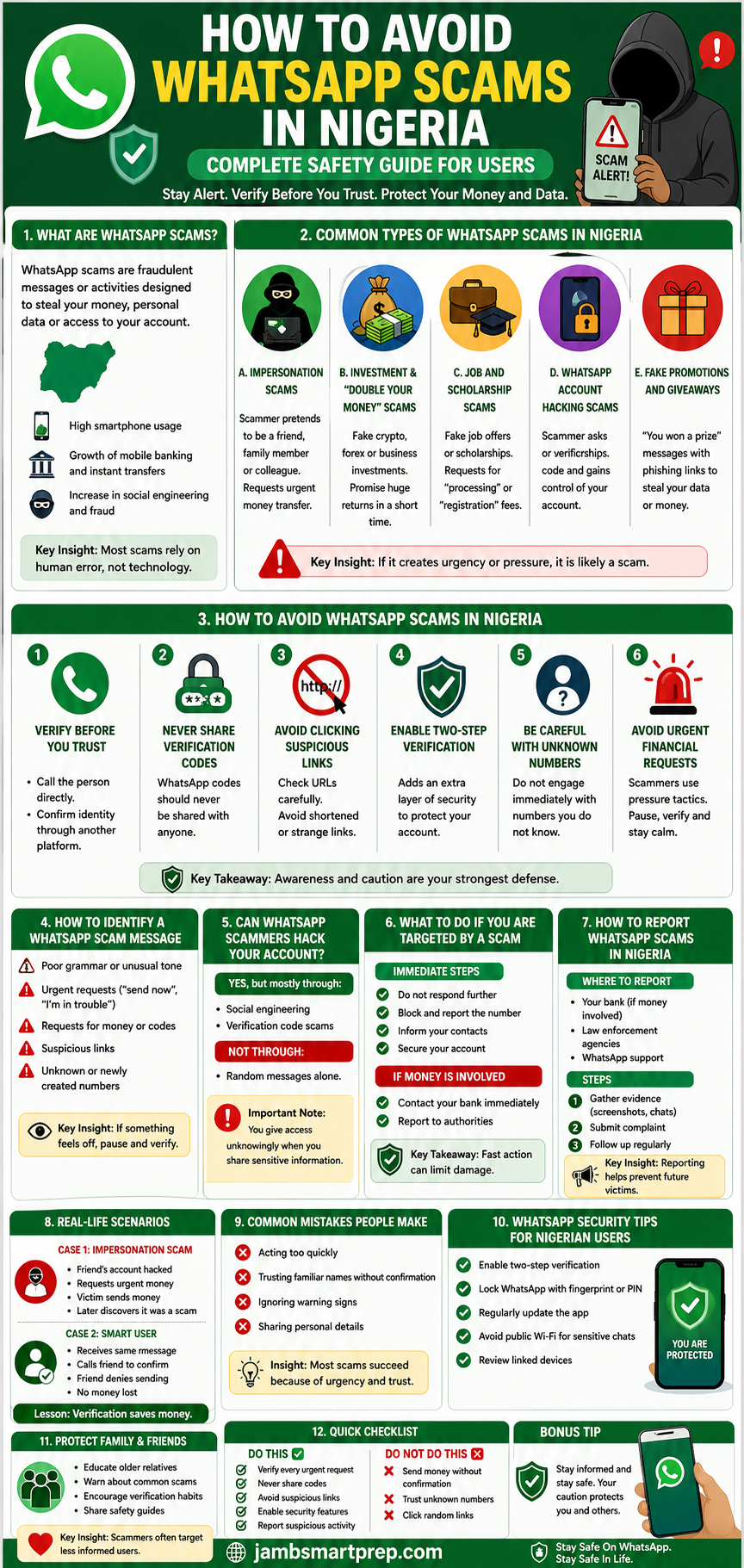
How to Avoid WhatsApp Scams in Nigeria (Complete Safety Guide for Users)
Common Scams:
- Impersonation
- Fake investments
- Giveaway scams
Warning Signs:
- Urgent requests
- Unknown numbers
- Suspicious links
Protection Tips:
- Verify identity
- Enable two-step verification
- Never share codes
Golden Rule:
If it feels urgent and suspicious, pause and verify.
Conclusion
Learning how to avoid WhatsApp scams in Nigeria is no longer optional. It is part of everyday digital safety.
Most victims are not careless. They simply act too quickly in stressful situations.
If you remember one thing from this guide, let it be this:
Pause before you act.
Take Action Today:
- Enable your WhatsApp security settings
- Educate friends and family
- Always verify before sending money
Final Thought:
Have you ever received a suspicious WhatsApp message? What did you do in that moment?