In Nigeria today, choosing the right course of study is more than just following passion. With unemployment rates hovering around 4.3% (National Bureau of Statistics, 2024), students need to be deliberate about selecting courses that can guarantee employability, entrepreneurship, or global career mobility.
A degree that leads to strong job prospects, high demand, and competitive pay is a smart investment. For instance, many Nigerian graduates who studied computer science or nursing are already securing international jobs in Canada, the UK, and the United States.
This guide highlights the best courses to study in Nigeria for job opportunities in 2026, using reliable career demand trends and examples of thriving graduates.
Criteria for Ranking “Best Courses”
The courses listed here were ranked using these factors:
-
Industry Demand: Courses linked to Nigeria’s fastest-growing sectors (healthcare, tech, energy).
-
Employability Rate: Graduates’ chances of getting jobs after NYSC.
-
Salary Prospects: Average monthly or annual pay.
-
International Relevance: Courses with global opportunities.
-
Entrepreneurship Potential: Fields where graduates can create self-employment.
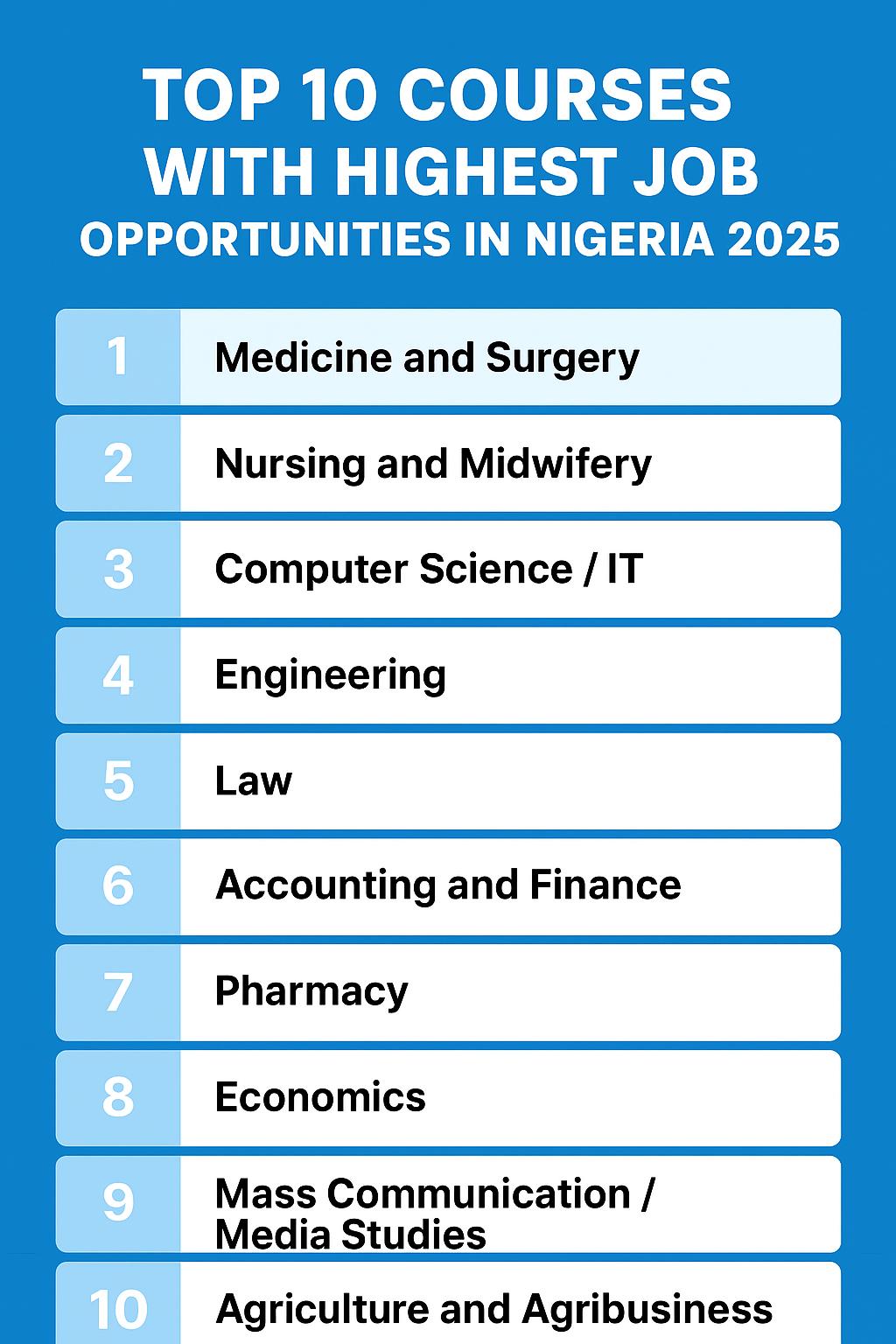
Top 10 Courses in Nigeria with Job Opportunities in 2026
1. Medicine and Surgery
-
Why: Doctors remain in high demand due to Nigeria’s doctor-patient ratio (1 doctor per 5,000 people vs. WHO recommendation of 1 per 600).
-
Job opportunities: Hospitals, private practice, international recruitment.
-
Salary: ₦250,000 – ₦1 million/month (depending on specialization).
2. Nursing and Midwifery
-
Why: Nurses are among the most sought-after professionals globally. Many Nigerian-trained nurses migrate to the UK and Canada.
-
Job opportunities: Clinics, teaching hospitals, global healthcare.
-
Salary: ₦150,000 – ₦700,000/month locally, higher abroad.
3. Computer Science / Information Technology
-
Why: Tech remains Nigeria’s fastest-growing sector, with fintech startups like Flutterwave and Paystack creating global impact.
-
Job opportunities: Software development, cybersecurity, AI, data analysis.
-
Salary: ₦200,000 – ₦1.5 million/month.
4. Engineering (Petroleum, Civil, Mechanical, Electrical)
-
Why: Infrastructure and oil/gas remain critical sectors.
-
Job opportunities: Oil companies, construction firms, government projects.
-
Salary: ₦250,000 – ₦1 million/month.
5. Law
-
Why: Lawyers play crucial roles in corporate, government, and private practice.
-
Job opportunities: Corporate firms, judiciary, international law.
-
Salary: ₦120,000 – ₦800,000/month depending on specialization.
6. Accounting and Finance
-
Why: Every business needs accountants. Chartered accountants (ICAN/ACCA) are highly employable.
-
Job opportunities: Banks, firms, entrepreneurship.
-
Salary: ₦150,000 – ₦600,000/month.
7. Pharmacy
-
Why: Pharmacists are essential in healthcare and pharmaceuticals. Self-employment opportunities are strong.
-
Job opportunities: Hospitals, pharmaceutical companies, drug stores.
-
Salary: ₦180,000 – ₦700,000/month.
8. Economics
-
Why: Economists thrive in policy-making, research, banking, and development organizations.
-
Job opportunities: CBN, banks, international NGOs.
-
Salary: ₦150,000 – ₦500,000/month.
9. Mass Communication / Media Studies
-
Why: Digital media and journalism are expanding rapidly with Nigeria’s 120M+ internet users.
-
Job opportunities: Broadcasting, public relations, content creation.
-
Salary: ₦100,000 – ₦400,000/month, higher for media entrepreneurs.
10. Agriculture and Agribusiness
-
Why: With Nigeria’s push for food security, modern farmers and agribusiness experts are in demand.
-
Job opportunities: Agro-processing, farming, export, research.
-
Salary: ₦100,000 – ₦350,000/month, with high entrepreneurial returns.
Future Careers to Watch in Nigeria
By 2030, some careers will dominate Nigeria’s job market. Students should also watch for:
-
Renewable Energy Engineers – solar, wind, and bioenergy.
-
Artificial Intelligence Specialists – robotics, automation.
-
Health Informatics Experts – merging medicine with IT.
-
Logistics and Supply Chain Managers – driven by e-commerce growth.
-
Environmental Scientists – tackling climate change and sustainability.
10 Tips for Choosing the Right Course
-
Know your strengths: Align courses with subjects you perform well in (e.g., strong in Biology? Think Medicine/Nursing).
-
Research job demand: Check NBS or JAMB statistics for high-demand fields.
-
Talk to professionals: Ask alumni and industry experts about career realities.
-
Consider global mobility: Choose courses that can land you jobs abroad.
-
Look beyond money: Passion + skill = long-term career satisfaction.
-
Check admission requirements: Ensure you meet WAEC/JAMB subject combinations.
-
Think entrepreneurship: Courses like Agriculture, IT, and Pharmacy offer self-employment.
-
Stay updated with trends: Careers evolve with technology and global markets.
-
Plan for postgraduate study: Some courses need specialization.
-
Be flexible: If your first choice isn’t available, pick a related field with similar opportunities.
Conclusion
Choosing the best courses to study in Nigeria for job opportunities in 2026 requires balancing passion with market demand. Courses like Medicine, Nursing, IT, and Engineering remain strong, while emerging fields in AI, renewable energy, and health informatics will shape the future.
As you prepare for JAMB or post-UTME, ensure you select wisely. Remember, your course determines not just your job prospects, but also your financial independence and career satisfaction.
Stay updated with more study tips, scholarship updates, and admission guides by subscribing to our blog.
FAQs on Best Courses to Study in Nigeria 2026
1. What is the highest paying course in Nigeria?
Medicine, IT, and Petroleum Engineering rank among the top-paying courses.
2. Which course has the best international opportunities?
Nursing, Computer Science, and Law provide strong global career pathways.
3. Can I succeed in Agriculture as a career in Nigeria?
Yes, agribusiness is highly profitable if you embrace modern farming techniques.
4. Which course is easiest to get a job after NYSC?
Nursing and Accounting graduates generally secure jobs faster.
5. What is the best science course apart from Medicine?
Pharmacy and Nursing are excellent alternatives.
6. Which course is best for someone good in Mathematics?
Engineering, Computer Science, and Economics are strong options.
7. Is Law still relevant in 2026 Nigeria?
Yes, especially with corporate and international law demand rising.
8. What is the JAMB cut-off mark for Medicine in Nigeria?
Usually between 270–300, depending on the university.
9. Which course offers the best self-employment chances?
Pharmacy, Agriculture, and Mass Communication are strong for entrepreneurship.
10. Can I switch courses after first year in university?
Yes, but it depends on your university’s transfer policies.
