
Preparing for JAMB can feel overwhelming. Many students read for long hours, attend extra lessons, and still struggle to score high. It is not always about how hard you read. In most cases, the real issue is poor structure.
Without a clear plan, even the most serious student can waste time jumping from one subject to another. That is why learning how to create a personal study timetable for JAMB 2026 is so important.
In this guide, you will learn how to build a simple and realistic timetable that fits your daily life. Whether you are a science, art, or commercial student, the steps here will help you stay focused and prepared.
Why You Need a Personal Study Timetable for JAMB 2026
A well-planned JAMB study timetable 2026 can change how you prepare for the exam.
Every year, over 1.5 million candidates register for JAMB in Nigeria. Yet, only a small percentage score above 250. One key difference between high scorers and average candidates is how they manage their time.
Here is why a timetable matters:
1. It Helps You Cover the Full Syllabus
JAMB questions come directly from the official syllabus. A timetable ensures you do not skip important topics.
2. It Builds Daily Reading Discipline
When you know what to read and when to read it, procrastination reduces.
3. It Reduces Exam Pressure
Students who plan ahead rarely panic close to the exam date.
4. It Supports CBT Preparation
Since JAMB is fully computer-based, timed practice is essential. A timetable helps you include CBT sessions regularly.
Things to Consider Before Creating Your Timetable
Before jumping into your best study plan for JAMB students, take a step back and think through a few important details.
Know Your JAMB Subjects and Syllabus
Every candidate writes four subjects. Use the official syllabus to guide your reading. This prevents wasting time on irrelevant topics.
Understand Your Daily Schedule
Be honest about your routine:
- School hours
- Lesson periods
- Household chores
- Rest time
A timetable that ignores your daily life will not work.
Identify Your Strong and Weak Subjects
If Physics is difficult for you, it deserves more attention than English, which you may already understand well.
Choose Your Best Study Time
The best time to study for JAMB exams depends on your personal rhythm.
- Morning readers: Fresh mind, fewer distractions
- Night readers: Quiet environment, deeper focus
Pick what works for you and stay consistent.
Step-by-Step Guide to Creating a Personal Study Timetable for JAMB 2026
Now let us break down how to create a practical timetable you can actually follow.
Step 1: List All Your Subjects
Write down your four JAMB subjects. For example:
- English (compulsory)
- Mathematics
- Physics
- Chemistry
Step 2: Set Clear Study Goals
Avoid vague plans like “read Biology today.” Be specific:
- “Study photosynthesis and solve 20 past questions”
- “Revise trigonometry formulas”
Daily and weekly targets keep you focused.
Step 3: Allocate Time Blocks
A common question is: how many hours to read for JAMB daily?
The answer depends on your schedule, but a good range is:
- Weekdays: 2–4 hours
- Weekends: 4–6 hours
Break your time into sessions:
- 1 hour per subject
- Short breaks in between
Step 4: Break Subjects into Topics
Do not just write “Chemistry” in your timetable. Divide it into topics:
- Atomic structure
- Chemical bonding
- Organic chemistry
This makes your study measurable and organized.
Step 5: Include Revision and Practice Tests
This is where many students fail.
Strong JAMB CBT study tips include:
- Weekly CBT practice
- Timed past questions
- Mock exams
At least twice a week, test yourself under exam conditions.
Step 6: Add Breaks and Rest Time
Reading without rest leads to burnout.
Follow a simple pattern:
- 50 minutes reading
- 10 minutes break
This improves focus and memory.
Sample JAMB Study Timetable (Science, Art & Commercial Students)
Here is a simple sample JAMB timetable for science students. You can adjust it based on your needs.
Weekday Plan
Morning (Before School):
- English (30–45 minutes)
Afternoon (After School):
- Mathematics (1 hour)
Evening:
- Physics or Chemistry (1 hour)
- Revision (30 minutes)
Weekend Plan
Morning:
- Mathematics (1.5 hours)
Afternoon:
- Chemistry (1 hour)
- Physics (1 hour)
Evening:
- CBT Practice (1 hour)
For Art or Commercial Students
Replace subjects accordingly:
- Government
- Literature
- Economics
- Commerce
The structure remains the same.
Remember, your timetable should be flexible. Adjust it when necessary.
Best Practices to Follow Your Timetable Consistently
Knowing how to read for JAMB and pass is not just about planning. It is about discipline.
Here are practical tips:
- Start small. Do not overload your first timetable
- Focus on consistency, not perfection
- Track your progress weekly
- Study even when you do not feel motivated
A simple habit done daily beats an intense plan you cannot sustain.
Common Mistakes Students Make When Creating a JAMB Timetable
Avoid these errors if you want your plan to work:
- Setting unrealistic reading hours
- Ignoring difficult subjects
- Skipping revision sessions
- Avoiding CBT practice
- Copying another student’s timetable
Your timetable should reflect your own life and learning pace.
Tools and Resources to Improve Your Study Plan
To strengthen your JAMB reading timetable guide, use the right tools:
1. JAMB CBT Practice Apps
App like JAMBSmartPrep help simulate real exam conditions.
2. Past Questions and Answers
Most JAMB questions repeat in pattern. Practice regularly.
3. Study Groups
Reading with friends can improve understanding and motivation.
4. Simple Planners
Use notebooks or printed schedules to track your daily progress.
Study Timetable for JAMB 2026
Step 1: List your 4 JAMB subjects
Step 2: Set daily and weekly goals
Step 3: Allocate 2–4 hours daily
Step 4: Break subjects into topics
Step 5: Add CBT practice weekly
Step 6: Include revision and rest
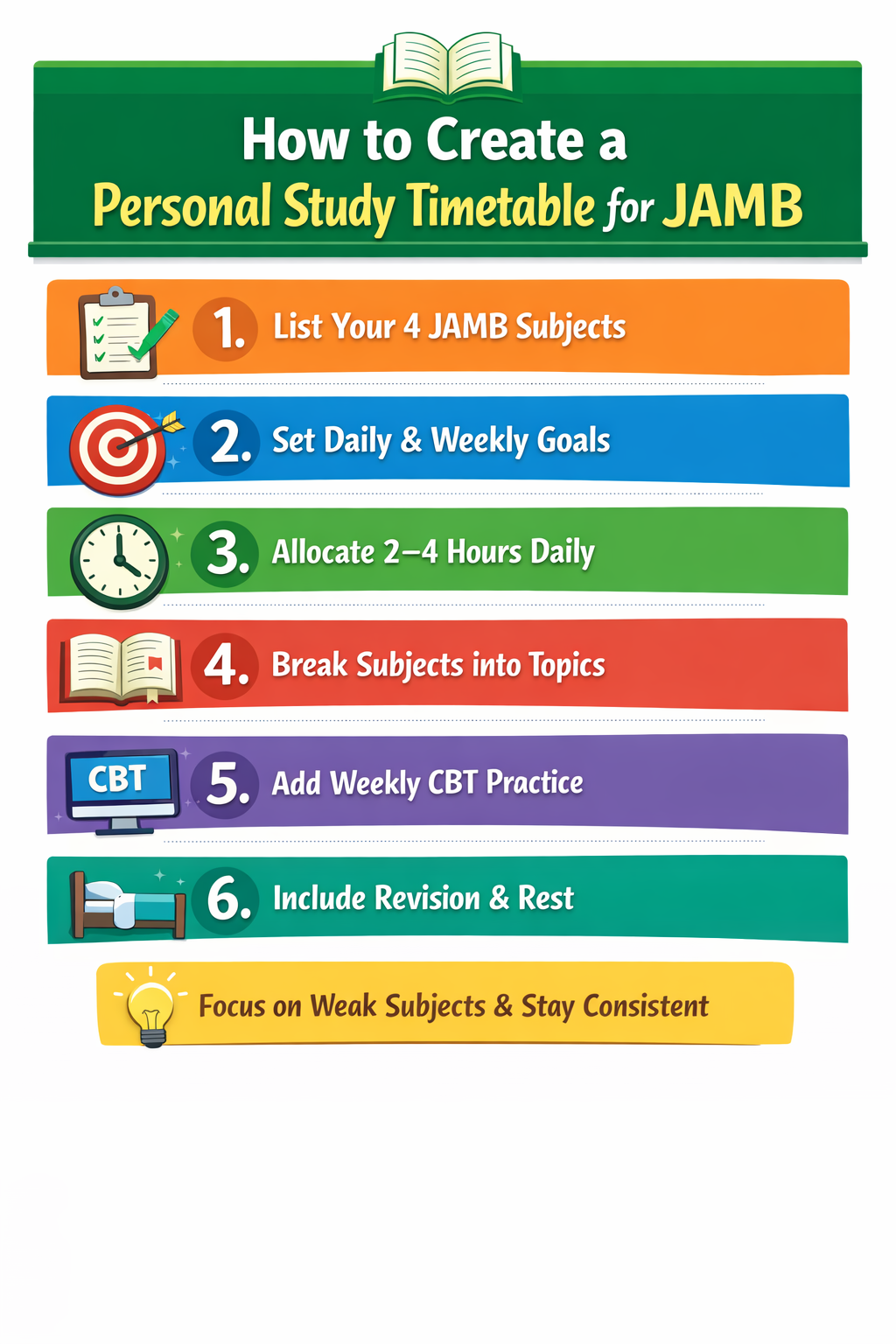
Pro Tip: Focus on weak subjects and stay consistent.
FAQs About JAMB Study Timetable
Can I pass JAMB without a timetable?
Yes, but it is difficult. A timetable gives structure and improves your chances of success.
How many hours should I study daily for JAMB?
Most students do well with 2–4 hours daily. Increase during weekends or holidays.
What is the best time to read for JAMB?
It depends on you. Early mornings and late nights are popular because they are quiet.
How do I balance school and JAMB preparation?
Use shorter study sessions on school days and longer sessions on weekends. Focus on quality, not just quantity.
How often should I revise?
At least once or twice a week. Revision helps you retain what you have studied.
What is the best study plan for JAMB students?
A balanced plan that includes:
- Daily reading
- Weekly revision
- Regular CBT practice
How can I stay consistent with my timetable?
- Set realistic goals
- Avoid distractions
- Track your progress
- Reward yourself after completing tasks
What subjects should I focus on more?
Spend more time on subjects you find difficult, but do not ignore your strengths.
Conclusion
A timetable is not a punishment. It is a tool that helps you stay in control of your preparation.
If you have been reading without results, this is the right time to change your approach. Start small. Build a timetable that fits your daily routine. Adjust it as you grow.
Most importantly, stay consistent.
Now is the best time to begin.
Try creating your personal timetable today and see the difference in your study pattern.
Which course are you planning to study in university? Let us know in the comments.
