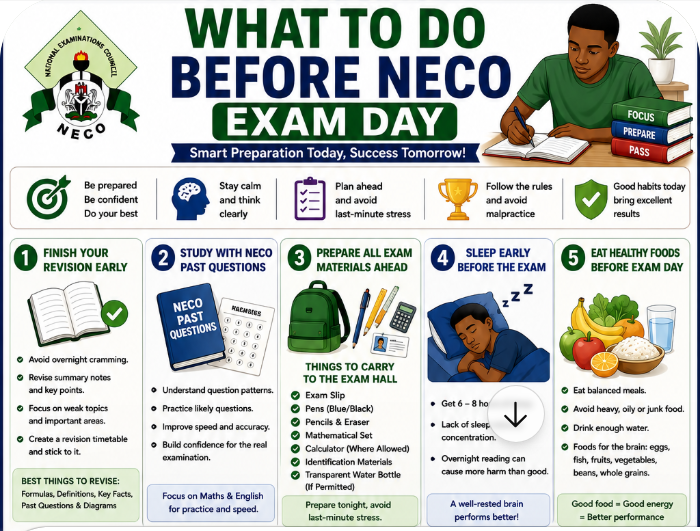
Before NECO exam day, confirm your timetable and exam number, check that your registration details and photocard are correct, revise with past questions rather than new topics, pack your permitted materials the night before, leave phones and any written material at home, sleep well, and arrive early. Malpractice is taken seriously: NECO reported 1,406 malpractice cases in its 2026 SSCE internal, and results can be withheld or cancelled, so preparation includes knowing the rules as well as the subjects.
This guide takes you from four weeks out to the moment you sit down for your first paper, with checklists for each stage, what to carry, how to handle practicals, and what to do if something goes wrong on the day.
- 4 weeks before: get your timetable; confirm your subjects, exam number and personal details with your school.
- 2–3 weeks before: timed past papers; fix weak topics; practise practical skills.
- 1 week before: light, focused revision; prepare materials; plan transport.
- The night before: pack your bag for tomorrow’s paper; check for any writing on items; sleep early.
- The morning: eat, re-check your bag, leave your phone, arrive early.
- Never: buy or carry “expo”, or take a phone or notes into the hall.
In this guide:
- Know your exam dates
- Four weeks before
- Two to three weeks before
- The week before
- The night before
- The morning of the exam
- In the exam hall
- What to carry and what to leave
- Preparing for practicals
- If something goes wrong
- FAQs
Know your exam dates
| Exam | Latest dates |
|---|---|
| 2026 SSCE internal (school candidates) | 15 June – 23 July 2026; results released 24 September 2026 |
| 2025 SSCE external (private candidates) | 26 November – 13 December 2025; results released in early February 2026 |
| 2027 SSCE (proposed) | 1 April – 14 May 2027, under a provisional harmonised timetable proposed by the Federal Government |
If the 2027 dates hold, NECO’s school exam will come much earlier than in 2026, and before WAEC’s proposed 11 May – 18 June window. Get the official timetable from your school or neco.gov.ng, and plan your revision backwards from your first paper.
Four weeks before
Administrative checks
- Get the official timetable and highlight every paper you’re registered for, including practicals.
- Confirm your registration with your school: subjects, name spelling, date of birth and exam number. If something’s wrong, ask the school to correct it now. See how to correct NECO registration mistakes.
- Collect your photocard or registration documents when your school issues them, and keep them in one safe place.
- Note your exam number in two places (paper and phone). You’ll need it for every paper and to check your result. See how to recover a lost NECO exam number.
Study plan
- List weak topics in each subject from recent tests and past papers.
- Make a four-week timetable that gives most time to weak topics and to English Language and Mathematics, which most courses require. See NECO reading timetable and daily study hours.
- Start timed past papers, one subject at a time.
A four-week countdown
| Week | Main goal | Daily routine (example) |
|---|---|---|
| 4 weeks out | Fix admin; identify weak topics | 2 hours weak topics; 1 hour English/Maths; 30 minutes recall |
| 3 weeks out | Timed papers in every subject | One timed paper; mark it; update error log |
| 2 weeks out | Close gaps; practical skills | Error log topics; one practical skill; English/Maths drills |
| Final week | Consolidate; rest | Short reviews; formula and diagram sheets; early nights |
Two to three weeks before
- Do full timed papers (objective and theory) for each subject, then mark them honestly.
- Keep an error log: what you got wrong, why, and the correct idea.
- Practise writing answers in full, not just reading notes. Theory papers reward clear, developed points.
- Review exam technique: command words, timing per question, showing working, labelled diagrams.
- Practise practical skills (see below).
- Use examiners’ advice: WAEC’s free e-learning portal shows how examiners mark common subjects, which is useful for NECO too. See how to use the WAEC e-learning portal.
For a full study approach, see how to study for NECO and how to prepare for WAEC and NECO in one month.
Revision techniques for the final weeks
- Active recall: close your notes and write everything you remember about a topic, then check.
- Spaced revision: revisit each weak topic every few days rather than once.
- Past papers under time: the closest thing to the real exam.
- Error log: re-test every mistake a few days later.
- Teach a friend: explaining a topic shows whether you really understand it.
- One-page summaries: condense each topic onto a single page for the final week.
See how to study without forgetting; the methods work just as well for NECO.
The week before
| Day | Focus |
|---|---|
| 7 days before | Last full timed paper in your weakest subject; update your error log |
| 6 days before | Formula sheets, key definitions and diagrams from memory |
| 5 days before | Error log re-test; short sets of questions |
| 4 days before | English and Mathematics practice; check your materials |
| 3 days before | Light revision; confirm transport and the centre (usually your school) |
| 2 days before | Light revision; buy any missing materials |
| 1 day before | Short review; pack your bag; sleep early |
Avoid starting big new topics in the final week. Focus on keeping what you know fresh and getting enough sleep.
Last-minute focus by subject
| Subject | What to review in the final days |
|---|---|
| English Language | Essay formats (formal and informal letters, articles, speeches); summary technique (one point per sentence, own words); common grammar errors; oral English sounds |
| Mathematics | Formula sheet from memory; past questions on your weakest topics; showing working; graph and construction skills |
| Biology | Labelled diagrams; food tests; enzymes; genetics ratios; ecology terms |
| Chemistry | Mole calculations; balanced equations with state symbols; ion and gas tests; organic reactions; IUPAC names |
| Physics | Formulas and units; graph interpretation; circuits; lens and mirror formulas |
| Economics | Demand and supply diagrams; elasticity calculations; definitions with examples |
| Government | Constitutional history timeline; arms of government; federalism; developed points with Nigerian examples |
| Literature in English | Themes, characters and techniques in set texts; literary terms; unseen poetry approach |
| Civic Education | Key concepts, rights and responsibilities, with examples |
| Trade/entrepreneurship subject | Key terms, processes and safety; practical requirements if any |
Use short, active sessions: write definitions from memory, redraw diagrams, and do five quick questions per topic.
Days with two papers
- Plan the break: eat a light meal, drink water and rest briefly between papers.
- Pack for both papers the night before, with separate pouches if materials differ.
- Don’t cram in the break. A quick look at key formulas or points is enough.
- Don’t discuss the first paper with friends in detail; it can unsettle you before the second.
Food, sleep and health during exam weeks
- Sleep 7–9 hours. Memory and concentration depend on it.
- Eat regular, balanced meals, including breakfast before morning papers.
- Drink water, and follow your centre’s rules on bringing water into the hall.
- Limit caffeine and energy drinks, which can disturb sleep.
- Take short walks or stretch between study sessions.
- If you need medication during the exam, tell your school in advance and show the supervisor.
The night before
- Check tomorrow’s paper: subject, paper number, date and time.
- Pack your bag for that paper using the checklist below.
- Check every item for writing: rulers, calculator covers, pencil cases, the back of your timetable.
- Sharpen pencils and test pens.
- Lay out your uniform.
- Do a light review of key points or formulas, then stop.
- Set two alarms and go to bed early.
The morning of the exam
- Wake early enough to avoid rushing.
- Eat breakfast and drink water.
- Re-check your bag, especially your photocard and permitted materials.
- Leave your phone at home or with a trusted person outside the centre.
- Leave early to allow for traffic or delays.
- Arrive early, use the toilet, and settle before the paper starts.
The right mindset on exam day
By exam day, the work is mostly done. What matters now is using what you know well. A few mindset habits help:
- Focus on the paper in front of you. Don’t think about the next paper or how friends are doing.
- Treat hard questions as normal. Every paper has some. Move on and come back.
- Trust your preparation. Past papers have trained you for this.
- Keep perspective. One paper is one part of your result, and there are routes to fix a weak grade later.
What your school should do
Schools play a big role in a smooth exam. Your school should give you your timetable and photocard, explain hall rules, arrange seating and practical materials, and keep candidates informed. If something seems wrong, such as a missing subject on your registration or a timetable clash, raise it with your exam officer straight away, not on the morning of the paper. Schools must also submit continuous assessment records; from the 2026/2027 session, new Federal Government guidelines set fixed windows for this.
In the exam hall
- Sit where you’re told and listen to all instructions before writing.
- Check the question paper: correct subject, paper and number of pages.
- Write your details exactly as instructed, including your exam number.
- Read every question carefully, especially the command words and the number of questions to answer.
- Plan your time by marks: spend more time on questions that carry more marks.
- Don’t communicate with other candidates: no talking, signalling or borrowing.
- Raise your hand if you need anything.
- Check your answers and details before submitting.
If you feel anxious, see how to stay calm during WAEC and NECO exams.
Technique for theory papers
- Read the rubric: how many questions, from which sections, and any compulsory questions.
- Choose questions wisely: spend the first few minutes picking the ones you can answer most fully.
- Follow the command word: “state” needs brief points; “explain” needs developed points; “discuss” needs points with explanation and, where relevant, both sides.
- Use the “state, explain, illustrate” structure for each point, with Nigerian examples where possible.
- Show all working in calculations, with units.
- Draw clear diagrams in pencil, with titles and ruled labels.
- Number answers exactly as the questions are numbered.
- Leave time to check details and spelling.
Technique for objective papers
- Shade carefully with an HB pencil, filling each box completely; erase cleanly if you change an answer.
- Answer easy questions first, then return to harder ones.
- Watch for “NOT” and “EXCEPT” in questions.
- Don’t leave blanks where there’s no penalty for guessing; eliminate options first.
- Keep your answer sheet clean and match each answer to the right question number.
Time allocation example
| Paper (example) | Time | Plan |
|---|---|---|
| Theory paper: answer 5 questions | 2 hours 30 minutes | 5 minutes choosing; about 27 minutes per question; 10 minutes checking |
| Objective paper: 60 questions | 1 hour | About 50 seconds per question on the first pass; 10 minutes to review |
These are examples; use the actual time and question numbers on your paper. If the duration on the question paper differs from your timetable, follow the instructions you’re given in the hall.
English and Mathematics: the papers that matter most
Because almost every course needs credits in English and Mathematics, give them special attention in the final weeks:
- English: write at least two timed essays a week in different formats, practise one summary passage every few days, and revise oral English sounds. Read your answers back for grammar and spelling.
- Mathematics: do a mixed set of questions daily, write your formula sheet from memory, and practise showing every step. Examiners can award method marks even when the final answer is wrong.
If you’re short of a credit in either after results, retaking the subject in a private series is a genuine route. See NECO vs WAEC for timing options.
What to carry and what to leave
| Carry | Leave at home |
|---|---|
| Photocard or identification as instructed by your school | Mobile phones, even switched off |
| Blue or black pens (2–3) | Smartwatches and earpieces |
| HB pencils, eraser, sharpener | Notes, textbooks or any written material |
| 30 cm ruler | Programmable calculators |
| Mathematical set (for Maths and technical papers) | “Expo” or any leaked material |
| Simple, non-programmable calculator where permitted | Anything with writing on it |
| Materials listed for practicals or art papers | Items not allowed by your school or NECO |
The rules are similar to WAEC’s; see our exam hall checklist for a detailed list.
Night-before bag check (tick each item)
| Item | Mon | Tue | Wed | Thu | Fri |
|---|---|---|---|---|---|
| Photocard / ID | ☐ | ☐ | ☐ | ☐ | ☐ |
| Timetable (clean copy) | ☐ | ☐ | ☐ | ☐ | ☐ |
| Pens (2–3) and HB pencils (2) | ☐ | ☐ | ☐ | ☐ | ☐ |
| Eraser, sharpener, ruler | ☐ | ☐ | ☐ | ☐ | ☐ |
| Maths set / calculator (if needed) | ☐ | ☐ | ☐ | ☐ | ☐ |
| No phone, notes or writing on items | ☐ | ☐ | ☐ | ☐ | ☐ |
Preparing for practicals
- Biology: practise drawing specimens with a title, ruled labels and magnification; revise features of common specimens.
- Chemistry: practise titration readings, tables and calculations; revise tests for ions and gases.
- Physics: practise recording readings, plotting graphs with suitable scales and calculating slopes.
- All practicals: record exactly what you observe, and write precautions specific to the experiment.
See how to prepare for WAEC and NECO practicals and how many marks practicals carry.
What counts as malpractice
NECO treats malpractice seriously. In 2026, it reported 1,406 malpractice cases in the SSCE internal, down from 3,878 in 2025, and it has withheld results of candidates found guilty of impersonation. Actions that can be treated as malpractice include:
- Bringing phones, smart devices or notes into the hall, whether used or not.
- Copying, sharing answers or communicating with other candidates.
- Using “expo” or leaked materials.
- Impersonation: someone writing the exam for another candidate.
- Writing messages, appeals or irrelevant content on scripts.
- Taking question papers or answer booklets out without permission.
- Disrupting the exam or threatening officials.
Consequences can include withheld or cancelled results for one subject or all. See how to pass NECO without malpractice.
Your exam number and photocard
Your exam number identifies you on every script and on your result. Before the exam:
- Copy it exactly from your photocard or registration slip.
- Keep a photo of your photocard on your phone at home (not in the hall) and a paper copy.
- Practise writing it correctly so you don’t make a mistake under pressure.
- Store your photocard with your timetable in one fixed place.
Plan for the unexpected
| Risk | Plan |
|---|---|
| Rain or traffic | Leave earlier than usual; know a second route |
| Transport falls through | Have a backup ride or extra transport money |
| Power cut the night before | Charge lamps; pack your bag before dark |
| Calculator battery fails | Test it the day before; bring a spare permitted calculator if allowed |
| Feeling unwell | Tell an adult early; inform the supervisor at the centre |
If something goes wrong
| Problem | What to do |
|---|---|
| You forgot your photocard | Tell the supervisor immediately and follow instructions; inform your school |
| You arrive late | Report to the supervisor at once; follow the rules on lateness |
| You feel ill | Tell the supervisor; get help; keep medical documents |
| Wrong question paper | Tell the supervisor before writing |
| You realise a phone is in your bag | Hand it over before the paper starts as instructed; don’t hide it |
| Someone offers “expo” | Refuse; report to your principal. Using it risks your whole result |
Managing nerves in the days before
Feeling nervous is normal and can even help you focus. Keep it manageable:
- Stick to a routine: regular study, meals and sleep times.
- Use evidence: look at your improving past-paper scores to remind yourself you’re prepared.
- Breathe slowly for a minute when you feel tense: in for four counts, out for six.
- Avoid panic-spreading groups on social media, especially those sharing “expo” rumours.
- Talk to someone you trust if anxiety becomes overwhelming.
See how to stay calm during WAEC and NECO exams.
If you’re writing NECO and WAEC
Many school candidates sit both exams. Under the proposed 2027 timetable, NECO’s SSCE (1 April – 14 May) would come before WAEC’s WASSCE (11 May – 18 June), with only a short overlap. That means:
- Your NECO preparation is also WAEC preparation; the content overlaps heavily.
- Plan a few rest days between the exams if the timetables allow.
- Keep both photocards, timetables and exam numbers separate and clearly labelled.
- Learn each exam’s specific rules and formats, including any computer-based WASSCE papers.
See NECO vs WAEC.
Example situations
Blessing finds an error in her name. Four weeks before the exam, Blessing notices her surname is misspelt on her registration slip. She tells her exam officer immediately, who requests a correction through NECO’s process, avoiding problems with her certificate and JAMB records later.
Musa has two papers in one day. He packs separate pouches for Mathematics and Physics the night before, eats a light lunch between papers, and avoids discussing the morning paper with friends.
Kemi is offered expo. A classmate shares a “leaked” Chemistry paper on WhatsApp the night before. Kemi deletes it, reports it to her principal and revises her error log instead. The “leak” turns out to be fake.
Daniel forgets his calculator. He raises his hand and asks the invigilator, rather than borrowing from a neighbour, and shows full working by hand for the questions he can’t calculate quickly.
After each paper
- Stop writing when told and submit as instructed.
- Don’t talk until you’ve left the hall.
- Collect your belongings and check you have your photocard.
- Avoid long post-mortems; note one or two lessons and move on.
- Re-pack for the next paper as soon as you get home.
If you’re a private (external) candidate
NECO’s SSCE external is usually held around November–December. Without a school to remind you, plan carefully:
- Keep your registration slip, exam number and centre details safe.
- Visit your centre before the first paper to plan your route.
- Prepare your own timetable and revision plan; focus on the subjects you need for admission.
- Pack materials yourself, using the checklist above.
- Check results on results.neco.gov.ng when released (the 2025 external results came out in early February 2026).
For parents
- Help your child confirm the timetable and registration details early.
- Keep phones at home on exam days, or agree on where they’ll stay.
- Provide quiet study time, regular meals and an early bedtime.
- Arrange transport so your child arrives early.
- Talk openly about malpractice: discourage “expo” firmly, and explain the risks to the whole result.
Myths about NECO exam preparation
| Myth | Fact |
|---|---|
| “Everyone uses expo, so I should too.” | Most expo is fake, and malpractice can lead to withheld or cancelled results. NECO reported 1,406 cases in 2026. |
| “Staying up all night helps.” | Sleep loss harms memory and concentration. |
| “The night before is for learning new topics.” | It’s for light review and packing. |
| “A phone is fine if it’s off.” | Possession alone can be treated as malpractice. |
| “Practicals don’t need preparation.” | They test skills you should practise beforehand. |
Final checklist
- ☐ Timetable printed and checked
- ☐ Registration details and exam number confirmed
- ☐ Photocard in a safe, fixed place
- ☐ Materials ready; items checked for writing
- ☐ Timed past papers done for every subject
- ☐ Practical skills practised
- ☐ Transport planned
- ☐ Phone arrangement agreed
- ☐ Early nights planned for exam weeks
Why your NECO result matters for admission
Your SSCE result is part of your admission record. Most courses require at least five credits (A1 to C6), including English Language and usually Mathematics, in subjects relevant to the course. In the 2026 SSCE internal, 84.70% of candidates obtained five credits irrespective of English and Mathematics, but only 58.67% did so including both. That gap shows why English and Mathematics deserve extra attention in your final weeks.
After results, you’ll check them on results.neco.gov.ng, and upload them to JAMB at an accredited CBT centre so they show on CAPS. See how to check your NECO result and WAEC and NECO grading.
Summary
Good NECO preparation is part study and part organisation. Confirm your timetable and registration early, use timed past papers and an error log in the weeks before, keep the final week light, pack your bag the night before, leave your phone and any notes at home, and arrive early. Stay away from expo: it’s usually fake, and it can cost you your whole result.
After the exam period
Once your last paper is done, take a short break, then turn to what comes next. If you’re applying for admission, make sure you’re registered for the UTME (or plan to register), and know that you can register as “awaiting result” and upload your NECO result later at an accredited CBT centre. Keep your photocard and exam number safe for checking your result. In 2026, NECO released SSCE internal results on 24 September, 63 days after the last paper. If your result is delayed or withheld, see what to do if your NECO result is withheld.
Beware of scams after the exam too: people offering to “upgrade” results or sell cheap result tokens. See how to avoid NECO result scams.
Keep this checklist handy and tick it off as you go; small habits on the days before an exam make a real difference on the day itself.
Most importantly, believe in the work you’ve already put in.
You’ve got this.
Stay calm and steady, and take one paper at a time.
Frequently asked questions
What should I do the day before NECO?
Light revision, pack your bag for the next paper, check items for writing, lay out your uniform, and sleep early.
Can I take my phone to the NECO exam hall?
No. Leave it at home or with someone outside the centre.
When is NECO 2027?
A provisional timetable proposed by the Federal Government would hold NECO’s SSCE from 1 April to 14 May 2027. Confirm with NECO’s official timetable.
What happens if I’m caught with expo?
It’s malpractice. Your result can be withheld or cancelled. See NECO result withheld.
Should I study on the morning of the exam?
A short look at key formulas or points is fine. Avoid heavy studying that leaves you tired or anxious.
What if I don’t finish my revision?
Focus on high-value topics and past questions in the last days. It’s better to sleep well and recall what you know than to cram.
Can I bring water into the NECO hall?
Follow your centre’s rules. Where allowed, use a clear bottle without labels.
Do I need my photocard for every paper?
Bring your photocard or the identification your school instructs for every paper.
Is NECO harder than WAEC?
There’s no reliable evidence that either is harder. In 2026, their pass rates for five credits including English and Mathematics were close. See NECO vs WAEC.
What if I miss a paper?
Tell your school immediately and follow NECO’s guidance. A missed paper usually means no grade in that subject for the sitting.
Can I use a pen for diagrams?
Use a sharp HB pencil for diagrams, so you can correct mistakes and draw clean lines, unless instructions say otherwise.
What should I eat before the exam?
A normal, balanced breakfast that you’re used to. Avoid trying new foods on exam days.
What if my timetable has a clash?
Tell your school’s exam officer immediately. Clashes are handled through official arrangements, not by choosing one paper.
How should I revise the day before a practical?
Review the skills you’ll need: recording observations, drawing tables, plotting graphs, writing precautions and, for Biology, drawing specimens. Check your pencils, ruler and eraser.
Is it okay to discuss the paper after the exam?
Once you’ve left the hall, briefly, yes. But don’t let it distract you from the next paper.
How early should I arrive?
Early enough to be seated before the paper starts; aim for at least 30–60 minutes before, depending on distance.
Prepare well, pack early, and walk in calm. Good luck with your NECO papers.
Related guides: How to study for NECO · Pass NECO without malpractice · Stay calm during exams · NECO registration requirements
