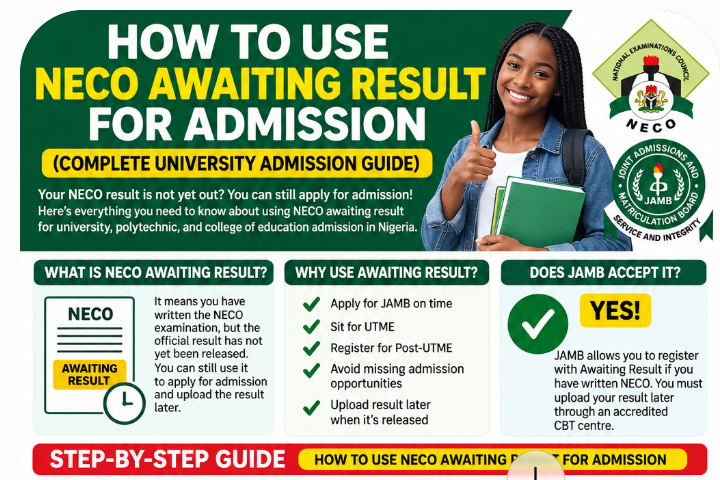
Yes, you can use a WAEC or NECO awaiting result for admission in Nigeria. JAMB lets you register for the UTME while awaiting your O’level result, and many universities, polytechnics and colleges of education let you apply for Post-UTME screening with one. But there’s a catch most guides skip. Your actual result must be released, meet your course requirements, and be uploaded to JAMB and submitted to your institution before their deadlines. Otherwise, your admission can’t be approved on CAPS, even if your school has already shortlisted you.
This guide answers the questions candidates actually ask. Which universities accept NECO results? Which schools accept awaiting results? How does the process work from UTME to CAPS? What deadlines should you plan around, and how do you protect yourself if your result is delayed, withheld or short of a credit?
- Does JAMB accept awaiting results? Yes, at UTME registration. But you must upload the actual result to your JAMB profile before admission can be approved.
- Which universities accept NECO results? NECO SSCE is a national O’level examination accepted by JAMB and Nigerian universities, polytechnics and colleges of education, alongside WAEC.
- Which schools accept awaiting results? Many do, but rules change yearly. Check the current year’s official Post-UTME or screening advert for your institution.
- The key rule: once your result is out, upload it to JAMB (at an accredited CBT centre, or online for WAEC results) and submit it to your institution immediately.
In this guide:
- What “awaiting result” means
- Which universities accept NECO results?
- Which schools accept awaiting results?
- How awaiting results work, from UTME to CAPS
- Timeline: when results come out vs admission deadlines
- How to upload your result to JAMB once it’s out
- The risks, and how to protect yourself
- Combining results: one sitting vs two sittings
- Polytechnics, colleges of education and Direct Entry
- What to do in common situations
- FAQs
What “Awaiting Result” Means
An awaiting result (often shortened to “AR”) means you’ve sat your O’level examination (WAEC SSCE, NECO SSCE or a GCE) but the result hasn’t been released yet. It’s common because of how the Nigerian calendar works: the UTME and most screening exercises are planned while final-year students are still writing, or waiting for, their WAEC and NECO results.
It matters because O’level results are a core admission requirement. JAMB and your institution need to see that you have the required credits, usually including English Language and Mathematics plus subjects relevant to your course, before your admission can be confirmed.
Awaiting result vs having a result
| Awaiting result | Result released | |
|---|---|---|
| Register for UTME | Yes, indicate that you’re awaiting | Yes |
| Apply for Post-UTME or screening | Often yes, if the institution allows it | Yes |
| O’level upload to JAMB | Not yet possible | Required: at an accredited CBT centre, or online for WAEC results |
| Admission approved on CAPS | No, it needs your uploaded result | Yes, if all requirements are met |
Which Universities Accept NECO Results?
This is one of the most searched questions, and the answer is simpler than many students fear: NECO’s Senior School Certificate Examination (SSCE) is a recognised national O’level examination, accepted by JAMB and by Nigerian universities, polytechnics and colleges of education for admission, in the same way as WAEC’s SSCE.
What differs between institutions isn’t whether they accept NECO, but:
- Which credits you need for your course;
- Whether you can combine two sittings (for example, NECO and WAEC) for your course;
- Whether you need the result at screening, or can present it later (awaiting result);
- Whether they’ll verify your result, which NECO supports through its official verification service. See how to verify a NECO result.
If anyone tells you a particular university “doesn’t accept NECO”, ask them to show you the institution’s official admission requirements. Unless the institution itself states a restriction for a specific course, NECO is treated as an O’level result like WAEC.
NECO vs WAEC for admission
| Question | NECO SSCE | WAEC SSCE |
|---|---|---|
| Accepted by JAMB? | Yes | Yes |
| Accepted by Nigerian universities? | Yes | Yes |
| Grading | A1 to F9 | A1 to F9 |
| Usual results release | Later in the year (2026: 24 September) | Earlier (2026: 5 August) |
| Result checking | results.neco.gov.ng | waecdirect.org |
For more detail, see NECO vs WAEC and WAEC vs NECO grading.
Which Schools Accept Awaiting Results?
There’s no single official national list. Each institution decides, and its rules can change from one year to the next, or even between faculties. Treat any list you find online, including this section, as a starting point to verify, not a guarantee.
Institutions reported to have accepted awaiting results in recent exercises
Education news sites have reported that many institutions accepted awaiting-result candidates for screening in recent years, on condition that the result was submitted before a deadline. The names commonly reported include:
| Type | Institutions commonly reported |
|---|---|
| Federal universities | Ahmadu Bello University (ABU), University of Ibadan (UI), University of Lagos (UNILAG), Bayero University Kano (BUK), Federal University of Technology Akure (FUTA), University of Benin (UNIBEN), University of Ilorin (UNILORIN), University of Nigeria Nsukka (UNN), Obafemi Awolowo University (OAU), University of Port Harcourt (UNIPORT) |
| State universities | Lagos State University (LASU), Ladoke Akintola University of Technology (LAUTECH), Ekiti State University (EKSU), Delta State University (DELSU) |
| Private universities | Covenant University, Babcock University, Afe Babalola University |
Important: these names are reported by third parties, not confirmed for the current year by the institutions themselves. Before you rely on any of them, read the institution’s current screening advert on its official website or portal.
What real announcements look like
Institutions’ own notices show how awaiting-result rules work in practice:
- In 2025, the University of Abuja announced that candidates whose Post-UTME registration had stalled because their NECO results were still pending could complete registration once the results were available on its portal, if they had already paid and started registration before the closing date.
- UNN was reported to have set a deadline (30 September) for candidates to upload or validate their O’level results in a recent exercise.
The pattern is clear. Institutions are often flexible about applying with an awaiting result, but strict about deadlines for the actual result.
How to check an institution’s rules for this year
- Go to the institution’s official website or admissions portal (not a blog).
- Open the current year’s Post-UTME, screening or admission advert.
- Search the advert for “awaiting”, “O’level” and “deadline”.
- Note whether awaiting-result candidates can apply, by what date the result must be submitted, and how (upload on the school portal, JAMB upload, or both).
- Check the institution’s official social media pages for later updates.
- If anything is unclear, contact the admissions office in writing and keep the reply.
How to read a screening advert: what to look for
Screening adverts are long, and the awaiting-result rules are often buried. Look for these phrases and note what each one tells you:
| Phrase in the advert | What it tells you |
|---|---|
| “Candidates awaiting results may apply” | You can register for screening now |
| “…must upload their results on or before [date]” | Your hard deadline. Put it in your calendar. |
| “…not later than [time] after release of results” | A deadline that counts from the results release date |
| “Not more than two sittings” | You can combine two results |
| “One sitting only” (for named courses) | Those courses need all credits in one result |
| “O’level results will be screened/scored” | Your grades affect your ranking, not just eligibility |
| “Upload on the portal” vs “Upload on JAMB CAPS” | Where you must submit; often both |
| “Candidates who fail to upload… forfeit admission” | The consequence of missing the deadline |
How Awaiting Results Work, From UTME to CAPS
- UTME registration: when you register, indicate that you’re awaiting your O’level result. See how to register for JAMB.
- Write the UTME and check your score. See how to check your JAMB result.
- Apply for Post-UTME or screening, indicating “awaiting result” where the form allows. Some portals let you add your result later.
- Sit the screening, if your institution holds one.
- Your O’level result is released. Check it immediately. See how to check your NECO result.
- Upload the result to JAMB, at an accredited CBT centre or, for WAEC results, online on e-Facility.
- Submit or update the result on your institution’s portal before its deadline.
- Your institution recommends you on CAPS, and JAMB approves the admission.
- Accept the offer on CAPS. See how to know if JAMB has given you admission.
JAMB’s guidance is clear on one point: candidates with awaiting results must upload their results once available. Without the upload, institutions’ recommendations for them can’t be considered.
Timeline: When Results Come Out vs Admission Deadlines
This is where awaiting-result candidates win or lose. Compare when your result is likely to be out with when admissions close.
| Event | 2026 timing | What it means for you |
|---|---|---|
| WAEC SSCE (school) results | Released 5 August 2026 | Usually in time for most screening deadlines |
| NECO SSCE Internal results | Released 24 September 2026 | Later; can be tight for some institutions’ deadlines |
| Public universities’ admission deadline | 31 October 2026 (reported, from JAMB’s 2026 policy meeting) | Your result must be uploaded and processed well before this |
| Private universities’ deadline | 30 November 2026 (reported) | A little more time |
| Polytechnics, monotechnics and colleges of education | 31 December 2026 (reported) | The longest window |
| Acceptance of offers on CAPS | Within four weeks of the offer (reported for 2026) | Offers not accepted are withdrawn |
Result release dates and admission deadlines change every year, so check the current year’s announcements. The principle stays the same: if your result comes out late, you have less time to upload and be processed. Have everything else ready so you can act on the day your result is released. Even a delay of a few days can matter when your institution’s deadline is close and CBT centres are crowded.
How to Upload Your Result to JAMB Once It’s Out
- Check your result on the official portal: results.neco.gov.ng for NECO, or waecdirect.org for WAEC.
- Print the result and note your examination number and year.
- Visit an accredited CBT centre for the O’level upload. See JAMB-accredited CBT centres.
- Bring your details: JAMB registration number, result printout, examination number and year, and any scratch card or token if the centre needs it.
- Check every subject and grade before the operator submits.
- Confirm the upload on your JAMB profile (on CAPS, under your O’level record).
For full details and common upload problems, see what happens if you don’t upload your O’level result.
WAEC results: you can now upload online
Since August 2026, 2026 UTME candidates with WAEC results can verify and upload them from home. You get a verification code, then apply the result through the “2026 UTME O’Level Upload” option on e-Facility. The result is checked directly against WAEC’s records. JAMB’s announcements covered WAEC first. For NECO results, use an accredited CBT centre unless JAMB announces that NECO has been added. See our O’level upload guide for the full steps.
Don’t forget your institution’s portal
Uploading to JAMB doesn’t automatically update your school’s portal. Many institutions ask you to enter or upload your result on their own portal too, sometimes with a deadline and a separate fee. Do both.
The Risks, and How to Protect Yourself
| Risk | What can happen | How to protect yourself |
|---|---|---|
| You miss a required credit | You don’t meet your course requirements, and the offer falls through | Choose courses you’re confident you’ll qualify for; register for a GCE as a backup if a subject is borderline |
| Your result is delayed or pending | You miss the upload deadline | Act fast; see NECO result pending |
| Your result is withheld | You can’t present a result | Respond to NECO immediately; see NECO result withheld |
| Your result is cancelled | The result can’t be used | See NECO result cancellation |
| Details don’t match (name or date of birth) | Delays at upload or clearance | Correct errors early; see correcting errors on a NECO result |
| You forget the institution’s portal | Your school doesn’t see your result | Upload to both JAMB and your school’s portal |
| You can’t check your result | Delays in printing and uploading | See NECO result portal problems and token not working |
Consider a GCE as insurance
If you’re unsure about one subject, consider registering for a NECO GCE or WAEC GCE as a backup. If your SSCE result comes out fine, you won’t need it. If it doesn’t, the GCE may help you meet requirements for the following year, or this year if your institution accepts combined sittings and timing allows.
Know Your Course’s O’level Requirements Before Results Come Out
An awaiting result is only a problem if the real result doesn’t meet your course’s requirements. So find out exactly what your course needs before results are released. Most degree courses ask for five credits, including English Language and Mathematics, plus subjects related to the course. The exact subjects vary by institution, so check your institution’s brochure or JAMB’s official brochure on the e-Facility portal.
| Course area | Credits typically required (always confirm) | Common trap |
|---|---|---|
| Medicine, Nursing, Pharmacy | English, Mathematics, Biology, Chemistry, Physics | A pass (D7/E8) in Physics or Chemistry, often from rushing practicals |
| Engineering | English, Mathematics, Physics, Chemistry, plus one relevant science | Missing Further Mathematics or Technical Drawing where a department prefers it |
| Law | English, Mathematics, Literature in English, plus two arts or social science subjects | No credit in Literature in English |
| Accounting, Economics, Business | English, Mathematics, Economics, plus two relevant subjects | No credit in Economics |
| Mass Communication | English, Literature in English, plus three arts or social science subjects (Mathematics credit often required too) | Assuming Mathematics isn’t needed |
Also make sure your UTME subject combination matches the course. See JAMB subject combination for all courses.
How some schools use O’level grades in screening
Some institutions don’t just check that you have the credits; they score your O’level grades and add them to your UTME and Post-UTME scores to rank candidates. An A1 can earn more points than a C6. If your institution does this, an awaiting-result candidate’s final ranking can’t be calculated until the result is uploaded. That’s one more reason to upload the moment it’s released. Read your institution’s screening advert to see whether O’level grades count towards your aggregate, and whether one sitting is scored differently from two.
A Month-by-Month Plan for Final-Year Students
If you’re in SS3 and will apply with an awaiting result, this plan keeps you ahead:
| When | Do this |
|---|---|
| Before UTME registration | Choose your course and institution; check O’level and subject requirements; get your NIN |
| UTME registration | Register, indicating that you’re awaiting your result; choose the right subject combination |
| UTME period | Write the UTME; print your result slip |
| WAEC/NECO exams (around May–July) | Focus fully; your O’level grades decide whether your admission stands |
| Screening adverts (mid-year onwards) | Read your institution’s awaiting-result rules; register for screening before the deadline |
| Results release (WAEC usually August; NECO usually September) | Check your result the same day; upload to JAMB and your school’s portal immediately |
| Admission season (through to the admission deadline) | Check CAPS regularly; accept any offer promptly |
What to prepare in advance so you can move on result day
- A NECO result checker token or WAEC scratch card, bought from official channels in advance.
- Your examination number, and your JAMB registration number and login details.
- The nearest accredited CBT centre’s location and opening hours.
- Your institution’s portal login details.
- Money for the upload and any school-portal fees.
Combining Results: One Sitting vs Two Sittings
Many candidates have both WAEC and NECO, and plan to combine them. Here’s what to know:
- Many courses accept two sittings, where you combine credits from two examinations or two attempts.
- Some courses or institutions require one sitting, especially very competitive ones. Check your course’s requirements.
- Upload both results to JAMB if you plan to combine them.
- Some screening scores weight O’level grades, and may treat one sitting more favourably.
| Your situation | What to do |
|---|---|
| You have WAEC and are awaiting NECO | Upload WAEC now; upload NECO once released if you need it to complete requirements |
| You’re awaiting both | Upload each as it’s released; WAEC usually comes first |
| Your course requires one sitting | Make sure a single result will meet all requirements |
Polytechnics, Colleges of Education and Direct Entry
Polytechnics and monotechnics
Many polytechnics accept awaiting-result candidates for screening, with the same rule: the result must be uploaded and submitted before their deadline. Their 2026 admission deadline was reported as 31 December, later than for universities, which helps candidates whose results come out late.
Colleges of education
From the 2026/2027 exercise, NCE candidates with at least four credit passes were exempted from sitting the UTME, according to reports of JAMB’s 2026 policy meeting. They must still register with JAMB, and their admission is still processed through CAPS. That makes your O’level result even more central: without it, there’s nothing to assess.
Direct Entry
Direct Entry candidates usually still need O’level credits as well as their A-level, ND or NCE qualification. If your O’level is awaiting, read the institution’s Direct Entry requirements carefully. See the Direct Entry admission guide.
What to Do in Common Situations
“I’ve been shortlisted, but my NECO result isn’t out”
Keep watching NECO’s announcements, check your result the moment it’s released, and upload it to JAMB and your school’s portal immediately. If your school’s deadline is very close, contact the admissions office in writing, explain that your NECO result is pending, and ask whether there’s an extension.
“My result is out but I’m missing one credit”
Check whether a second sitting (WAEC, NECO or GCE) could fill the gap, and whether your course accepts two sittings. If not, consider a course whose requirements you meet, or plan for the next admission year with a GCE.
“My NECO result is pending or withheld”
Contact NECO through official channels straight away, and tell your institution in writing. See NECO result pending and withheld.
“I uploaded my result, but CAPS still says not admitted”
That often means your institution hasn’t processed your course yet. See why your admission isn’t showing on CAPS.
“My school’s portal won’t let me submit with an awaiting result”
Read the advert again: some institutions don’t accept awaiting results for certain courses or programmes. If the advert says awaiting results are allowed, contact the admissions office with a screenshot.
After Admission: Your Result Will Be Checked Again
Getting your offer on CAPS isn’t the last time your O’level result matters. At clearance, institutions usually ask for your result printout or certificate, and many verify it directly with the examination body. For NECO, institutions use NECO’s official verification service. See how to verify a NECO result.
- Keep your printout and token or scratch card details. You may need them again.
- Make sure your details match across your result, your JAMB profile and your birth certificate. See correcting a wrong date of birth on a NECO certificate.
- Collect your certificate when it’s ready. See the NECO certificate collection guide.
For Parents: How to Help an Awaiting-Result Candidate
Parents can make a real difference during this period, mostly by keeping track of dates and money so the candidate can focus on exams:
- Keep a shared calendar of screening registration dates, results release dates and upload deadlines.
- Budget for the costs that come quickly after results: the result checker, the JAMB O’level upload, screening and school-portal fees, and acceptance fees.
- Keep the documents together: the birth certificate, NIN slip, passport photographs, registration slips and result printouts.
- Use official channels only. Don’t pay anyone who promises to “secure” admission.
- Have a plan B ready, such as a polytechnic, a related course or a GCE, so a disappointing result isn’t a crisis.
See also how parents can help children prepare for JAMB.
Checklist for Awaiting-Result Candidates
- ☐ Indicate “awaiting result” correctly at JAMB registration.
- ☐ Choose a course whose O’level requirements you’re confident you’ll meet.
- ☐ Read your institution’s current screening advert for awaiting-result rules and deadlines.
- ☐ Register for your institution’s screening on time.
- ☐ Prepare your result checker token or scratch card in advance.
- ☐ Check your result on the day it’s released.
- ☐ Upload it to JAMB immediately (online for WAEC results, or at an accredited CBT centre).
- ☐ Submit or update it on your institution’s portal before the deadline.
- ☐ Monitor CAPS and accept any offer promptly (within four weeks, as reported for 2026).
- ☐ Keep copies of everything.
Mistakes That Cost Awaiting-Result Candidates Admission
- Waiting days or weeks to upload after results are out.
- Uploading to JAMB but not to the school portal, or the other way round.
- Relying on an unofficial list without checking the institution’s own advert.
- Choosing a course they’re unlikely to qualify for, with no backup.
- Ignoring a pending or withheld result instead of acting immediately.
- Paying “agents” who claim to speed up uploads or admission. Use only official channels.
Frequently Asked Questions
Which university accepts NECO results?
NECO SSCE is a recognised national O’level examination accepted by JAMB and by Nigerian universities, polytechnics and colleges of education. Check your course’s specific credit requirements.
Is there a list of universities that accept NECO results in Nigeria?
You don’t need a special list: NECO is accepted alongside WAEC. What varies is the course requirements and whether two sittings are allowed.
Which schools accept awaiting results?
Many universities, polytechnics and colleges of education allow awaiting-result candidates to apply for screening, but rules change every year. Confirm in the institution’s official screening advert for the current year.
Can I use an awaiting result for JAMB?
Yes. You can register for the UTME while awaiting your result. You must upload the actual result once it’s released before admission can be approved.
Can I get admission with an awaiting result?
You can apply and be shortlisted, but your admission can’t be finalised on CAPS until your actual result is uploaded and meets the requirements.
What is the deadline for uploading an awaiting result?
Each institution sets its own, and it must also fit within JAMB’s admission deadlines. For 2026, admission deadlines were reported as 31 October (public universities), 30 November (private universities) and 31 December (polytechnics, monotechnics and colleges of education).
Does NECO result come out in time for admission?
Usually, but it’s later than WAEC’s (24 September in 2026 vs 5 August), so you have less time. Be ready to upload on the day it’s released.
Can I combine WAEC and NECO for admission?
Many courses accept two sittings, but some require one. Check your course’s requirements.
Where do I upload my awaiting result?
At a JAMB-accredited CBT centre for your JAMB profile, and on your institution’s portal if it requires it.
Do polytechnics accept awaiting results?
Many do, under the same condition: submit your actual result before their deadline. Check the polytechnic’s current advert.
Can I write Post-UTME with an awaiting result?
Many institutions allow it. Check the current advert for your institution and course.
What happens if my result doesn’t meet the requirements?
Your admission for that course can’t be approved. Consider a course you qualify for, a second sitting where allowed, or a GCE for the following year.
Can I check my NECO result before uploading it to JAMB?
Yes, and you should. Check it on results.neco.gov.ng first, so you know your grades and spot any errors before you upload it. If something is wrong with your details or grades, deal with it before you rely on the result.
My WAEC result is out but NECO isn’t. Which should I upload?
Upload WAEC now if it meets your requirements on its own. If you need NECO to complete your credits, upload NECO too as soon as it’s released, and confirm your course accepts two sittings.
What does “AR” mean on JAMB?
AR stands for “awaiting result”. It shows that you registered for the UTME before your O’level result was released.
Can I change my course while awaiting my result?
JAMB runs a change-of-course and change-of-institution service on the e-Facility portal. But don’t change your course while an institution is processing you unless it says you can, because a change can affect your consideration. See changing course or institution after the UTME.
Is a NECO result as good as a WAEC result for admission?
Yes. Both are national SSCE examinations graded from A1 to F9, and both are accepted for admission. Your grades matter more than which examination you sat.
Can I get admission with a NECO GCE result?
GCE results are O’level results, and many institutions accept them. Check whether your course accepts GCE, and whether you’re combining it with another sitting.
Related guides: Uploading O’level results to JAMB · Checking your NECO result · JAMB admission status on CAPS · Post-UTME admission steps
