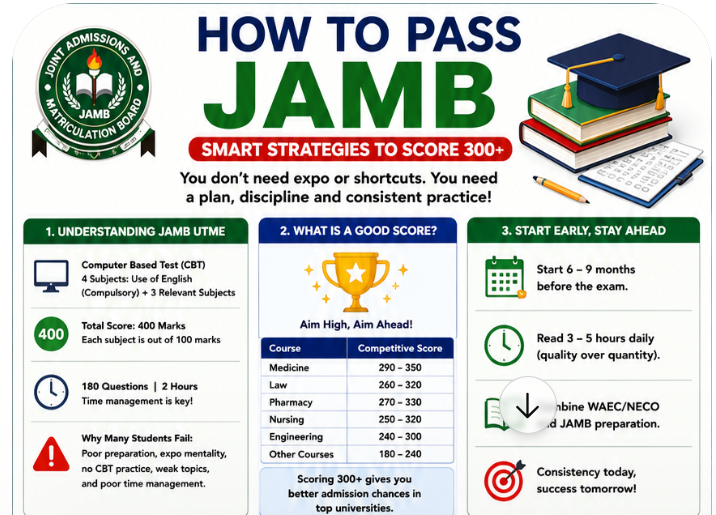
To pass JAMB, you need to cover the JAMB syllabus for your four UTME subjects, practise past questions until the question styles feel familiar, train on a computer under timed conditions, read the recommended Use of English text, and walk into the CBT hall with a plan for the 180 questions and two hours. Most candidates who score well aren’t unusually gifted. They start early, practise far more questions than average, and fix their weak topics instead of re-reading what they already know.
This guide is the complete version. It explains what “passing” JAMB really means in 2026–2027, how the exam is structured and scored, how much preparation time you need, a step-by-step study system, subject-by-subject tactics, a 12-week plan, what to do in the exam hall, and the mistakes that keep good students below their potential. If you only have a few weeks, jump to short on time.
- Confirm your subject combination for your course, then get the JAMB syllabus for all four subjects.
- Set a target score based on your course and institution, not just JAMB’s minimum.
- Cover the whole syllabus topic by topic, using a good textbook alongside the syllabus.
- Practise past questions after each topic, then full timed papers.
- Practise on a computer every week: 180 questions in 2 hours.
- Read the recommended English text completely.
- Keep a mistakes notebook and re-do every wrong question.
- Use a three-pass strategy in the hall: easy questions first, then medium, then hard.
- Avoid “expo” and runs completely.
In this guide:
- What “passing” JAMB actually means
- How the UTME works
- The 2026 numbers: how candidates actually scored
- How much time you need to prepare
- The 8-step system for passing JAMB
- Subject-by-subject tactics
- A 12-week study plan
- Short on time: 4-week and 2-week plans
- Exam hall strategy
- Mistakes that cost candidates marks
- Can you pass JAMB without studying?
- After the exam
- Frequently asked questions
What “passing” JAMB actually means
JAMB doesn’t have a single pass mark in the way WAEC does. Instead, it sets a minimum admissible score each year, below which institutions can’t admit you, and each institution and course then sets its own, usually higher, cut-off. In 2026, the minimum for universities was 150 and for polytechnics 100.
So when you ask “how do I pass JAMB?”, the real question is “what score do I need for my course at my chosen institution, and how do I reach it?” A score of 180 might be a pass for a less competitive course at a state university and a fail for Medicine at a popular federal university. Our cut-off marks guide explains how to find the right target.
| Goal | Rough UTME target | What that means per subject (out of 100) |
|---|---|---|
| Meet the university minimum | 150+ | About 38 average |
| Competitive for many courses | 200–230 | About 50–58 average |
| Competitive for popular courses | 250–280 | About 63–70 average |
| Top courses at top institutions | 280–300+ | About 70–75+ average |
These bands are guides, not official cut-offs. Institutions also weigh Post-UTME scores and sometimes O’level grades, so a slightly lower UTME score can sometimes be balanced by a strong screening performance.
How the UTME works
The Unified Tertiary Matriculation Examination (UTME) is a computer-based test (CBT) taken at JAMB-accredited centres. If you’re new to it, our guide what is UTME? explains the basics.
| Feature | Details |
|---|---|
| Subjects | Four: Use of English (compulsory) plus three subjects relevant to your course |
| Questions | 180 in total: 60 in Use of English, 40 in each of the other three subjects |
| Time | 2 hours for all four subjects |
| Score | Each subject is scored out of 100, total 400 |
| Format | Multiple choice, on a computer, using the mouse and keyboard shortcuts |
| Questions per candidate | Drawn from a large question bank, so neighbouring candidates see different questions |
Two hours for 180 questions works out at 40 seconds per question on average. That’s the single most important number in this guide. Speed and accuracy on a computer are skills you train, not things you hope for. See JAMB CBT time management and how many questions JAMB sets.
Because English has 60 questions but is still worth 100 marks, each English question is worth less than a question in your other subjects. JAMB doesn’t publish an official formula, but our guide to how JAMB calculates scores explains the commonly cited estimates and what they mean for your strategy.
The 2027 timetable
A harmonised 2027 timetable proposed by the Federal Government and shared by JAMB places the UTME around 15 to 25 March 2027, earlier than the April window used in 2026. JAMB also announced that for the first session of the 2027 UTME, candidates should arrive by 7:30am (instead of 6:30am), with the exam running from 8:30am to 10:30am. These dates were described as provisional, so confirm them on jamb.gov.ng. If they hold, you have less time than previous sets did, so start now.
The 2026 numbers: how candidates actually scored
JAMB reported 2,243,816 registered candidates for the 2026 UTME, written at about 966 CBT centres from 16 April, with four sessions a day. Its reported score distribution shows how scores spread out:
| Score range | Number of candidates |
|---|---|
| 300 and above | 12,414 (about 0.6%) |
| 250–299 | 73,441 |
| 200–249 | 334,560 |
The highest reported score was 372. Put simply, about 420,000 candidates scored 200 or more, and the large majority scored below 200. That has two lessons. First, a score of 200+ already puts you ahead of most candidates. Second, getting to 250+ requires more than ordinary preparation. The strategies below are designed for both.
How much time you need to prepare
There’s no single right answer, but a rough guide based on where you start helps you plan:
| Your starting point | Suggested preparation time |
|---|---|
| Strong student, good school foundation | 3–4 months of focused practice |
| Average student | 5–6 months, starting early in SS3 |
| Weak foundation in one or more subjects | 6+ months, with extra help for weak subjects |
| Repeating candidate | 3–6 months, focusing on what went wrong last time |
Daily study time matters too. Consistent sessions of two to four hours on school days and longer at weekends work for many candidates. Our guide how many hours to study per day for JAMB has sample schedules. If you have three months, see a three-month JAMB study plan.
The 8-step system for passing JAMB
Step 1: Lock in your course and subject combination
Everything starts here. Use of English is compulsory, but the other three subjects must match your course’s requirements, and institutions sometimes differ. Check JAMB’s brochure on e-Facility before registration. A wrong combination can make you ineligible no matter how high you score. JAMB itself, in a November 2026 advisory for 2027 candidates, told candidates to confirm their subjects match their preferred course. See JAMB subject combinations for all courses.
Step 2: Get the syllabus and turn it into a checklist
The JAMB syllabus lists every topic that can be examined in each subject. Print it, or copy the topics into a notebook, and turn it into a checklist with three columns: covered, practised, confident. This gives you a clear map and stops you wasting time on topics JAMB doesn’t test. See how to use the JAMB syllabus.
Step 3: Learn each topic properly
Use a standard textbook to understand each topic, not just a summary pamphlet. For each topic, read the explanation, write short notes in your own words (definitions, formulas, key facts), and work through examples. Then move straight to step 4. Our guide how to read for JAMB without forgetting covers techniques that help information stick.
Step 4: Practise past questions topic by topic
Immediately after learning a topic, do past questions on it. This shows you how JAMB asks about it, which details matter, and which traps appear. Mark yourself honestly. For every wrong answer, find out why. See how to use JAMB past questions and mistakes students make with past questions.
A common question is whether JAMB repeats past questions. Exact repeats are not something to rely on, but topics and question patterns recur often, which is why past questions are so valuable. See does JAMB repeat past questions?
Step 5: Keep a mistakes notebook
Every question you get wrong goes into a notebook: the question (or a summary), the correct answer, and the reason you missed it. Was it a knowledge gap, a careless error, a misread question, or a time problem? Re-do these questions a week later. This is one of the highest-value habits in JAMB preparation, because it focuses your time on what you don’t know.
Step 6: Train on a computer under exam conditions
Once you’ve covered a good portion of the syllabus, start full timed practice: 180 questions in 2 hours, on a computer if possible. Do at least one full mock a week in the last two months. Get comfortable with navigating between subjects, flagging questions, using keyboard shortcuts and watching the timer. See JAMB CBT practice guide and JAMB CBT for beginners.
Step 7: Read the recommended English text
JAMB sets questions on a recommended text in Use of English. For 2025 and 2026, that text was The Lekki Headmaster by Kabir Alabi Garba. JAMB announces the text for each year, so confirm the 2027 text when it’s announced. Read the whole book, not just a summary: the questions often test details of characters, events and settings. See The Lekki Headmaster guide and Lekki Headmaster questions and answers.
Step 8: Review, adjust and taper
Every week, review your mock scores by subject and your mistakes notebook. Shift time toward your weakest subject and weakest topics. In the final week, stop learning new topics and focus on light revision, rest and logistics. See how to prepare for JAMB exam day.
Subject-by-subject tactics
Use of English
English is compulsory and has the most questions, so it shapes every candidate’s score. The main areas are comprehension and summary passages, the recommended text, lexis and structure (synonyms, antonyms, sentence completion, idioms), and oral English (vowels, consonants, stress and rhyme). Oral English is a common weak spot because it’s rarely taught well; it rewards focused practice with past questions. See Use of English areas of concentration.
Mathematics
Maths rewards practice more than reading. Make a formula sheet, practise calculation speed, and learn to estimate and eliminate options. Topics such as indices, logarithms, sets, quadratic equations, variation, sequences, coordinate geometry, mensuration, statistics, probability and basic calculus appear regularly. See JAMB Mathematics areas of concentration.
Physics
Physics combines formulas, units and concepts. Many candidates lose marks on unit conversions and misreading what the question asks. Practise motion, forces, energy, waves, light, electricity and magnetism, and modern physics. Know your SI units and common constants. See topics to read for JAMB Physics.
Chemistry
Chemistry needs both calculation (moles, gas laws, electrolysis, energy changes) and recall (periodic table trends, organic chemistry, industrial processes). Organic chemistry and calculations are worth focused practice. See JAMB Chemistry key topics.
Biology
Biology is broad and recall-heavy. Diagrams, classification, ecology, genetics and evolution, and human physiology are frequent. Short notes and spaced revision work well. See JAMB Biology important topics.
Arts and commercial subjects
For Literature, Government, Economics, CRS/IRS, Commerce, Accounting and others, the syllabus is your guide. Government and Literature in particular reward knowing specific facts (dates, constitutional provisions, prescribed texts). Economics and Accounting combine definitions with calculations. Use past questions to identify the most tested areas. See JAMB areas of concentration for the science subjects and the syllabus for others.
A 12-week study plan
This plan assumes you can study about three hours on weekdays and five hours at weekends. Adjust it to your situation.
| Weeks | Focus | Weekly target |
|---|---|---|
| 1–2 | Syllabus checklist, diagnostic mock, start the English text | One full diagnostic mock; cover 4–6 topics per subject |
| 3–6 | Learn and practise topics across all four subjects | 6–8 topics per subject; topic past questions after each; read 1/4 of the text each week |
| 7–8 | Finish the syllabus; start full timed mocks | Remaining topics; one full mock per week |
| 9–10 | Weak topics; mistakes notebook; speed | Two full mocks per week; redo mistakes |
| 11 | High-frequency topics; English text revision | Two to three mocks; short notes |
| 12 | Light revision, rest, logistics | One short mock early in the week; print slip; visit centre |
For a ready-made daily timetable, see JAMB reading timetable. If you’re writing JAMB and WAEC in the same year, see a combined JAMB and WAEC timetable.
Short on time: 4-week and 2-week plans
If you have 4 weeks
- Week 1: diagnostic mock; list your weakest topics in each subject; read half the English text.
- Week 2: high-frequency topics in your two weakest subjects; finish the text.
- Week 3: two full timed mocks; mistakes notebook; oral English.
- Week 4: one mock early; revise notes; rest; logistics.
If you have 2 weeks
- Focus on English (text, lexis, oral) and the most frequently tested topics in your other subjects.
- Do one full timed mock every two to three days, then review it.
- Learn the CBT navigation and shortcuts so you lose no time on the day.
- Sleep properly. Late nights in the last two weeks usually cost more than they gain.
For a structured final push, see how to boost your JAMB score in the final days.
Exam hall strategy
The three-pass strategy
- First pass: answer every question you can do quickly and confidently. Skip anything that takes too long.
- Second pass: go back to questions you skipped that you think you can solve with a bit more time.
- Third pass: make your best choice on remaining questions. There’s no negative marking in the UTME, so don’t leave anything blank.
Time checkpoints
Many candidates find it helpful to plan how long to spend per subject and to check progress at fixed points, for example at 30, 60 and 90 minutes. A typical approach is around 35–40 minutes for English and 25–28 minutes each for the other subjects, with a few minutes at the end for review. Adjust based on your strengths. See JAMB CBT time management.
Staying calm
If you blank on a question, move on. If the computer has a problem, raise your hand and inform the official; don’t try to fix it yourself. If anxiety rises, take a few slow breaths and focus on the next question. See how to stay calm during the JAMB exam.
Rules that matter
JAMB published a long list of banned items for the 2026 UTME, including phones, wristwatches, pens, calculators, smart glasses, smart rings, earpieces, jewellery, wallets and ATM cards, and said candidates found with them would be barred. Candidates are biometrically verified before entering. Read JAMB exam rules and regulations and what to carry on exam day before your exam.
Mistakes that cost candidates marks
- Studying without the syllabus, so time goes to topics JAMB doesn’t test.
- Reading only, without practising questions.
- Never practising on a computer, then wasting time in the hall.
- Skipping the recommended text, losing easy English marks.
- Spending too long on hard questions early in the exam.
- Ignoring the weakest subject because it’s uncomfortable.
- Cramming all night in the final days.
- Trusting “runs” or “expo”, which are fake or lead to cancelled results.
- Registration errors, such as the wrong subject combination or mismatched names. See common JAMB registration mistakes.
More are covered in common mistakes candidates make during the UTME.
Can you pass JAMB without studying?
This is one of the most searched questions about JAMB, so it deserves an honest answer. A candidate who doesn’t study at all may still score above 150 if they have a strong foundation from school, read widely and are comfortable with computers, but it’s a gamble, and it usually isn’t enough for a competitive course.
What people often mean by “without studying” is “without spending months reading textbooks”. There are efficient ways to prepare: focusing on high-frequency topics, practising past questions instead of re-reading notes, and doing timed mocks. Those approaches give the biggest gain per hour. What doesn’t work is relying on “expo”, “runs” or people claiming to have JAMB questions. The UTME is computer-based, questions are drawn from large banks, candidates are biometrically verified, and JAMB has cancelled results for malpractice. See how to pass JAMB without malpractice.
Building a study routine that lasts
Most candidates start JAMB preparation with energy, then drift after three or four weeks. The ones who score well usually aren’t more motivated; they’ve built a routine that keeps working when motivation dips.
- Study at the same time every day. A fixed slot, such as straight after school or early in the morning, turns studying into a habit instead of a decision.
- Use short, focused blocks. Forty to fifty minutes of real concentration, then a ten-minute break, is more productive than three hours of distracted reading.
- Start each session with questions, not reading. Ten past questions on yesterday’s topic warm you up and show you what you remember.
- End each session with a plan. Write down exactly what you’ll do in the next session so you can start immediately.
- Put the phone away. Notifications break concentration. Keep it in another room or switch it off during study blocks, except when you’re using it for CBT practice.
- Take one lighter day a week. Rest improves the quality of the other six days.
Studying alone vs in a group
Both have a place. Studying alone is best for learning new topics and doing timed practice. A small group of two to four serious candidates is useful for explaining topics to each other, comparing answers on past questions and keeping each other on track. Large groups tend to turn into social gatherings. If you join a group, agree a clear agenda for each meeting.
Using JAMB’s mock UTME
JAMB usually offers an optional mock examination a few weeks before the main UTME for candidates who indicate interest during registration. In 2026, JAMB released mock results at the end of March, ahead of the April UTME. The mock gives you a feel for a real CBT centre: the arrival process, biometric verification, the hall, and the software. It isn’t required and its score doesn’t count, but candidates who take it often feel calmer on the main day. If you choose it, treat it as a full rehearsal: prepare the night before, arrive early, and review your performance afterwards.
Your JAMB preparation checklist
| Item | Done? |
|---|---|
| Course and institution chosen, with a realistic backup | ☐ |
| Subject combination confirmed in JAMB’s brochure | ☐ |
| NIN details correct; JAMB profile created | ☐ |
| Registered at an accredited CBT centre; details checked | ☐ |
| Syllabus printed for all four subjects | ☐ |
| Recommended English text bought and read | ☐ |
| Past questions for all four subjects | ☐ |
| Weekly timed CBT practice scheduled | ☐ |
| Mistakes notebook started | ☐ |
| Exam slip printed; centre located | ☐ |
For registration steps, see how to register for JAMB, and if your slip won’t print, why you can’t print your JAMB slip.
Real situations
“I’m a repeating candidate. My last score was 168.”
Start by analysing what went wrong: which subjects were lowest, whether you ran out of time, and whether you practised on a computer. Then plan to fix those specific things. Repeating candidates often improve quickly once they switch from reading to active practice.
“I’m good in three subjects but very weak in one.”
Your weak subject is your biggest opportunity. Moving from 35 to 55 in it adds 20 marks; moving a strong subject from 70 to 75 adds only 5. Get targeted help early and do topic-based practice.
“I’m writing JAMB and WAEC at the same time.”
Most subjects overlap, so studying for one helps the other. The difference is format: JAMB is fast multiple choice; WAEC adds theory and practicals. Alternate between the two formats in your practice. See how to pass WAEC.
“I don’t have a computer.”
Use a school computer room, a relative’s laptop, or a café for timed sessions, and a CBT practice app for daily drilling. Even a few real computer sessions before the exam help a lot.
How to track whether your preparation is working
Preparation that feels busy isn’t always preparation that raises your score. Measure it. After every full mock, record your total, your score in each subject, the number of questions you didn’t reach, and your three most common error types. Over several weeks, you should see:
- your total rising, even slowly;
- fewer unanswered questions as your speed improves;
- your weakest subject closing the gap with the others;
- fewer repeat mistakes from your notebook.
If your scores are flat for three or four weeks, change something: switch to more topic practice in your weakest area, get help from a teacher, or check whether you’re reviewing your mistakes properly. Doing more of the same rarely breaks a plateau. Your mock scores won’t match your real UTME score exactly, because practice questions vary in difficulty, but the trend is a reliable signal.
After the exam
JAMB released 2026 results in batches, and candidates checked them by sending UTMERESULT to 55019 or 66019 from their registered phone number. See how to check your JAMB result. Then make sure your O’level results are uploaded or verified on JAMB’s system (see what happens if you don’t upload your O’level), prepare for Post-UTME (see how to prepare for Post-UTME), and monitor CAPS (see how to know if JAMB has given you admission).
Free: JambSmartPrep UTME Readiness Hub
Test yourself with today’s free 10-question UTME quiz. Every answer comes with an explanation, and the hub tracks your streak and your weakest topics.
Frequently asked questions
What is the pass mark for JAMB?
JAMB sets a minimum admissible score rather than a pass mark. For 2026, it was 150 for universities and 100 for polytechnics. Institutions and courses usually set higher cut-offs.
How many questions are in JAMB?
180: 60 in Use of English and 40 in each of your three other subjects, to be answered in 2 hours.
Is there negative marking in JAMB?
No. You lose nothing for a wrong answer, so answer every question.
How can I score 300 in JAMB?
You need about 75 out of 100 per subject. That takes full syllabus coverage, heavy past-question practice, weekly timed mocks and strong time management. See how to boost your JAMB score.
How do I pass JAMB Physics?
Master formulas and units, practise calculations daily, and do topic-based past questions. See topics to read for JAMB Physics.
What is the recommended English text for JAMB?
For 2025 and 2026 it was The Lekki Headmaster. Confirm the 2027 text when JAMB announces it.
When is JAMB 2027?
A proposed harmonised timetable places the 2027 UTME around 15 to 25 March 2027. JAMB described the dates as provisional, so check official announcements.
Can I use a calculator in JAMB?
Personal calculators are on JAMB’s banned items list. An on-screen calculator is provided on the CBT system.
Which JAMB subject is the hardest?
It depends on the candidate. Many find Mathematics, Physics or Chemistry hardest because of calculations, while others struggle with the breadth of Biology or Government. Your weakest subject in mocks is the one to prioritise, whatever it is.
Is JAMB hard?
The questions themselves are mostly at secondary school level and follow the syllabus. What makes the UTME challenging is the combination of four subjects, 180 questions, two hours and a computer screen. Candidates who prepare for that combination, not just the content, find it much more manageable.
Should I read textbooks or past questions?
Both, in the right order. Use textbooks to understand a topic, then past questions to practise it. Relying only on past questions leaves gaps; relying only on textbooks leaves you slow and unfamiliar with JAMB’s style.
How long does it take to prepare for JAMB?
Three to six months is typical, depending on your foundation. Starting earlier gives you more room to fix weak subjects, take several full mocks, and still rest properly in the final week before the exam.
Related guides: Preparing as a first-time candidate · Boost your JAMB score · JAMB subject combinations · JAMB exam day
