Welcome to Jambsmartprep.com, your no. 1 guide for Jamb, WAEC, NECO and admissions. In today’s post, we will be covering virtually everything you need to know about How to Protect Yourself From NECO Result Scams.
Yes, during the course of this online guide, you will learn how to spot NECO result scams, fake agents, phishing links and token fraud, and protect your money, result details and personal information. All you need to do to get what you want is to keenly follow all the instructions outlined in this post.
For those of us who may not be aware, checking an examination result should be a straightforward process. However, the period after NECO results become available can also attract fraudsters who take advantage of candidates who are worried about missing grades, pending results, withheld results, admission deadlines or result-checking problems.
National Examinations Council provides official online services for examination results and result verification. Its official website also provides access to its e-Verify service and other examination resources.
The problem begins when a candidate leaves the official channels and starts dealing with someone who claims to have a special connection inside NECO.
A scammer may promise to upgrade a grade, release a withheld result, remove a pending status, correct a result immediately or recover a missing result. The person may then ask for money, a result token, password, OTP or other personal information.
This guide explains how NECO result scams work, the warning signs to watch for and the steps you can take to protect yourself.
What Is a NECO Result Scam?
A NECO result scam is a fraudulent attempt to obtain money, examination information, login credentials or other personal information by pretending to offer legitimate help with a NECO result or related service.
The scam does not always begin with an obvious demand for money. Also read: NECO Result Problems: Common Issues and How to Fix Them
A fraudster may first contact a candidate with a message about a supposed problem with the candidate’s result.
For example:
“Your NECO result has been withheld. I can help you release it.”
Another scammer may say:
“Your result is missing from the system. Send me your examination number so I can check it.”
Someone else may offer:
“I can upgrade your F9 to C6 before your school sees the result.”
The common feature is that the person claims to have a special ability, authority or connection that the candidate cannot access through the normal process.
What Makes These Scams Dangerous?
NECO result scams can involve more than losing money.
A candidate who gives sensitive information to a fraudster could also expose:
- Result-checking credentials
- Email accounts
- Social media accounts
- Banking information
- Personal identification details
- Examination records
- Payment information
The safest approach is therefore to treat unexpected result-related requests with caution.
Why NECO Candidates Are Attractive Targets for Scammers
Scammers understand that examination results can carry enormous importance for Nigerian students.
A candidate may need an O’level result for:
- University admission
- Polytechnic admission
- College of education admission
- Scholarship applications
- Employment
- Result verification
- Personal records
NECO’s official e-Verify system is used for result verification and confirmation by individuals and institutions. The platform explains that individuals can verify results and generate verification reports, while institutions can conduct candidate verification.
This creates several opportunities for fraudsters to impersonate legitimate services.
1. Candidates Are Often Under Pressure
Imagine a student who has just discovered that one subject is missing from the result.
The student is worried about admission.
Then someone sends a WhatsApp message saying:
“I can fix the problem today. Send ₦50,000.”
Fear can make the offer appear attractive.
The candidate may pay without first checking whether the person is genuine.
2. Admission Deadlines Create Urgency
A candidate waiting for admission may be particularly vulnerable.
A scammer could say:
“Your school will reject you tomorrow if the result is not corrected.”
The purpose is to stop the candidate from thinking carefully.
A legitimate process should not require you to make an important financial decision simply because an unknown person has created panic.
If an admission deadline is involved, contact the institution directly and confirm what it actually requires.
3. Candidates May Not Know the Difference Between Result Statuses
Searches such as:
- NECO result missing
- NECO result pending
- NECO result withheld
- NECO result cancelled
- NECO result not showing
can lead candidates to people offering unofficial solutions.
A candidate may not know that these statuses can represent different situations.
That uncertainty gives scammers an opening.
For example, someone may hear that a candidate’s result is pending and immediately claim:
“I have a person in Abuja who can remove the pending status.”
There is no reason to trust such a claim simply because the person knows the candidate’s result status.
How NECO Result Scams Usually Work
Most result scams follow a fairly simple pattern.
Step 1: The Scammer Identifies a Worried Candidate
The fraudster may find candidates through:
- WhatsApp groups
- Facebook groups
- Telegram groups
- TikTok comments
- School discussion groups
- Online forums
- Classified advertisements
- Direct messages
- Fake websites
The scammer may present themselves as a result agent, examination consultant, school official or someone with an alleged connection to NECO.
Step 2: The Scammer Creates a Sense of Fear
The next step is often to convince the candidate that something is seriously wrong.
The message could claim:
“Your result has been flagged.”
Or:
“Your result will be cancelled if you don’t act now.”
Another common approach is:
“There is a mistake in your result, but you have only a few hours to correct it.”
The scammer wants the candidate to act before verifying the claim.
Step 3: The Scammer Offers a Special Solution
After creating fear, the person presents themselves as the solution.
Common promises include:
- Releasing a withheld result
- Removing a pending status
- Finding a missing result
- Correcting examination details
- Upgrading grades
- Restoring a cancelled result
- Checking a result on behalf of a candidate
- Verifying a result
- Supplying a result token
- “Connecting” the candidate to a NECO official
Some scammers may even provide fake testimonials from supposed previous clients.
Step 4: The Scammer Requests Payment or Information
The fraudster may ask for:
- Money
- Result-checking token
- Registration number
- Examination number
- Phone number
- Email address
- Password
- OTP
- Bank account information
- Card information
- Identity documents
A request for basic examination information is not automatically proof of fraud. The important question is who is requesting it, why it is needed and whether the request is part of a legitimate official process.
However, sensitive financial credentials such as a bank PIN or OTP should never be handed to an unknown person claiming to be a NECO agent.
Step 5: The Scammer Demands More Money
One payment may not be the end.
After receiving the first payment, the scammer may say:
“Your application has been approved, but you need to pay a processing charge.”
After another payment:
“There is a final verification fee.”
The candidate may continue paying because they have already invested money and believe the result will eventually be fixed.
This is one reason it is important to stop and verify the situation before making the first payment.
15 Common NECO Result Scams Candidates Should Know
1. Fake NECO Result Checker Websites
One of the most important risks is entering personal information on a website that only looks like an official NECO page.
A fraudulent website may copy:
- NECO logos
- Colours
- Page layouts
- Result-checking forms
- Government-style language
The appearance of a website does not prove that it belongs to NECO.
The official NECO website identifies itself as the National Examinations Council and provides links to its examination services, including e-Verify.
How to protect yourself
Do not click a result-checking link simply because someone posts it in a WhatsApp or Facebook group.
Instead, navigate to the official NECO website and use the relevant service from there.
2. Fake NECO Result Checker Apps
Another possible scam involves applications that claim to provide special NECO result services.
A candidate may be asked to download an unknown application or APK file.
This can create risks beyond the examination result itself.
An unknown application could potentially request access to information on your device or direct you to fraudulent payment pages.
Safer approach
Use the official NECO website and recognised online services instead of downloading an application simply because someone claims it can reveal or repair a result.
3. Fake NECO Result Agents on WhatsApp
WhatsApp is convenient for communication, but a WhatsApp profile is not proof that someone works for NECO.
A fraudster can create a profile with:
- NECO’s name
- NECO’s logo
- A photograph of an official
- The title “NECO Result Agent”
- Fake testimonials
- A long list of supposed successful candidates
None of these automatically proves that the person is authorised.
A common scam message
“I am an NECO staff member. Send your registration number and token. I will check the problem for you.”
Do not assume the claim is genuine.
If you need assistance, use NECO’s official support system. The official support portal allows users to submit tickets and receive assistance.
4. Fake Facebook and Social Media NECO Pages
Fraudsters can also create pages that look like official examination-related accounts.
They may publish posts such as:
“NECO result correction is now available.”
“Contact us privately to release your withheld result.”
“NECO result upgrade is open.”
The problem is that social media followers and comments do not establish official authority.
A page with thousands of followers can still be fraudulent.
What to check
Before trusting a social media account, verify the information independently through NECO’s official website.
Do not treat:
- Likes
- Followers
- Comments
- Testimonials
- Profile photographs
as proof that an account is an official NECO channel.
5. NECO Result Upgrade Scam
The promise of a better grade is one of the most dangerous forms of result fraud.
A scammer may tell a candidate:
“You got F9 in Mathematics, but I can change it to C6.”
Or:
“Your score is low. Pay me and I will upgrade the grade.”
Candidates who are disappointed with their results may be tempted to believe the offer.
The safest response is to walk away.
Do not give money to someone who claims they can secretly manipulate your examination grade.
A person who promises an impossible or unofficial result change should be treated as a major warning sign.
6. Withheld NECO Result Release Scam
Candidates with withheld results can be especially vulnerable because they are actively looking for a solution.
A fraudster may claim:
“I have a contact inside NECO. Pay me and your withheld result will be released.”
The candidate may be asked to provide:
- Examination number
- Registration information
- Phone number
- Token
- Payment
Do not assume that a person can release a withheld result simply because they claim to have an insider.
The correct approach is to establish the official status and follow the appropriate NECO process.
7. Pending NECO Result Scam
The same technique can be used with pending results.
A scammer may say:
“Your result is pending because of a system issue. I can remove it immediately.”
The promise of an instant solution is the warning sign.
A pending result should not be treated as an invitation to pay an unofficial agent.
8. Missing NECO Result Scam
A candidate whose result is not showing may search online for help.
That search can lead to advertisements or messages from people claiming:
“Send your details. We can recover your missing NECO result.”
Before dealing with such a person, establish what is actually wrong.
The result may be:
- Missing entirely
- Incomplete
- Pending
- Withheld
- Affected by a checking problem
These are not necessarily the same situation.
When the problem concerns the official result record, use the appropriate NECO support channel rather than relying on a stranger’s promise.
9. Fake NECO Result Correction Service
Fraudsters may also advertise services for correcting:
- Name
- Date of birth
- Gender
- Examination details
- Other candidate information
This is particularly dangerous because candidates may have genuine errors and therefore believe the service is legitimate.
The existence of a real correction procedure does not mean every person advertising correction services is authorised to carry it out.
Always verify the applicable procedure through NECO’s official channels.
10. Fake NECO Token Sellers
Candidates may also encounter people selling supposed NECO result-checking tokens.
A fraudster may:
- Advertise a cheap token.
- Receive payment.
- Send an invalid token.
- Stop responding.
Another scammer may send a link to a fake payment page designed to collect payment or personal information.
The safest approach is to use the appropriate official or authorised purchasing route and keep your payment evidence.
What we have covered so far
NECO result scams work because fraudsters understand how much examination results matter to candidates.
They exploit fear about missing, incomplete, pending, withheld and cancelled results, then offer quick solutions such as result upgrades, secret corrections or special access to NECO officials.
The most important rule is simple:
Do not let an urgent result problem push you into an unverified transaction.
Check the official NECO website, verify the exact status of your result and use the official support system when you need assistance. NECO’s support portal provides a ticketing system for candidates who need help with unresolved issues.
How to Identify Fake NECO Agents, Websites and Scam Messages
Knowing that NECO result scams exist is only the first step. The more useful skill is being able to recognise a suspicious offer before you send money, click a dangerous link or disclose information.
A scammer may sound convincing. They may use NECO’s name, display official-looking images, show screenshots of supposed successful candidates and even claim to know your result status.
None of these things proves that the person is genuine.
When dealing with anything related to your NECO result, result token, result verification or result correction, look at the process rather than the person’s claims.
20 Warning Signs of a NECO Result Scam
The following warning signs can help candidates identify fraudulent offers.
1. The Person Promises to Change Your Grade
This is one of the clearest warning signs.
If someone says:
“Send me your result and I will change the F9 to C6.”
or:
“I can upgrade your NECO score before the result is uploaded.”
you should stop the conversation.
Do not send money simply because the person claims to have a connection inside NECO.
2. The Person Claims to Have a Secret Connection Inside NECO
Scammers often use phrases such as:
- “I have someone at NECO.”
- “My brother works at NECO.”
- “I know an examiner.”
- “I have a connection in Abuja.”
- “I can reach the people handling your result.”
The purpose is to make the victim believe that normal procedures do not apply to them.
A person claiming to know someone inside an organisation is not proof of official authority.
If you have a genuine result problem, use the appropriate NECO process rather than paying someone based solely on a supposed personal connection.
3. You Are Told to Pay Immediately
Urgency is a common feature of online fraud.
A scammer may tell you:
“Pay within one hour or your result will be cancelled.”
Another may say:
“Today is the last chance to release your withheld result.”
The pressure is designed to prevent you from checking whether the claim is genuine.
What should you do?
Stop.
Verify the information independently.
If the matter concerns admission, contact the school directly. If it concerns your NECO result, check the official NECO channels.
4. Someone Requests Your OTP
An OTP is a security code used to confirm certain transactions or account activities.
You should never give an unknown person an OTP simply because they claim to be helping with your NECO result.
A supposed NECO agent who asks for a banking OTP should immediately raise suspicion.
If you have already disclosed an OTP connected to a financial account, contact your bank or financial service provider promptly and follow its security instructions.
5. Someone Requests Your Bank PIN
Your bank PIN is private.
It is not something you should give to a person claiming to be a NECO official, result agent or examination consultant.
The same applies to:
- ATM PIN
- Mobile banking PIN
- Internet banking password
- Card security information
- Account recovery codes
A genuine examination-related process should not require you to disclose your banking PIN to a stranger.
6. Someone Requests Your Email Password
A scammer may ask for your email password while claiming that it is needed to verify your NECO account.
Do not provide it.
Your email account can contain:
- Admission correspondence
- Personal documents
- Password-reset links
- Examination information
- Banking notifications
- Other private communications
If someone has already obtained your email password, change it immediately and secure the account.
7. The Website Address Looks Suspicious
A website can look professional and still be fraudulent.
Scammers can copy the appearance of legitimate websites and use familiar logos.
Before entering your information, carefully examine the website address.
Look for:
- Misspelled words
- Strange domain names
- Unnecessary subdomains
- Unfamiliar payment pages
- Links that redirect through several websites
- Addresses that do not correspond with the organisation they claim to represent
When in doubt, do not use the link sent by a stranger. Navigate to the official NECO website yourself.
8. The Person Sends You an Unknown Link
Be cautious when someone sends you a message such as:
“Click here to check your NECO result.”
or:
“Click this link to remove your pending status.”
Do not click immediately.
The link could lead to:
- A fake login page
- A fraudulent payment page
- A phishing website
- A malicious download
- A page designed to collect personal information
Instead, open the official NECO website independently and locate the appropriate service.
9. The Person Uses a Personal WhatsApp Number as “Official NECO Support”
A WhatsApp account can be created by almost anyone.
A profile displaying the NECO logo does not establish that the person works for NECO.
Be especially cautious when the account:
- Requests payment
- Promises result changes
- Demands your password
- Requests OTPs
- Offers secret result services
- Refuses to provide verifiable official information
NECO provides an official support portal for assistance with issues. Candidates should use recognised official channels rather than relying on an unknown WhatsApp contact.
10. The Person Refuses to Provide Verifiable Information
A genuine service should be reasonably verifiable.
A scammer may avoid simple questions such as:
- What is your official department?
- Where can I verify your identity?
- What is the official procedure?
- Where is this information published?
- Can I confirm this through NECO?
Instead, the person may respond:
“Don’t worry, I have connections.”
That is not verification.
11. The Person Demands Payment Before Explaining the Process
Be cautious when someone says:
“Pay first. I will explain everything after payment.”
This is especially suspicious when the person is promising to solve a serious result problem.
Before making payment, establish:
- What service is being offered
- Who is providing it
- Why payment is required
- Where the procedure is officially documented
- What the payment covers
12. The Person Guarantees a Result Change
Words such as guaranteed, 100%, sure approval and instant release should make you cautious when they are used in connection with examination results.
For example:
“I guarantee your withheld result will be released.”
or:
“Your grade will definitely be upgraded.”
A person who cannot legitimately control the examination process cannot honestly guarantee its outcome.
13. The Person Shows Testimonials as Their Main Proof
A scammer may show screenshots saying:
“Thank you, sir. You changed my result.”
or:
“My withheld result was released. God bless you.”
These screenshots may look convincing, but they are not independent proof.
Testimonials can be fabricated, copied from elsewhere or presented without context.
Before trusting a service, verify it independently.
14. The Person Tells You to Keep the Transaction Secret
A scammer may say:
“Don’t tell your parents.”
or:
“Don’t contact NECO about this.”
or:
“This is a confidential method that only a few people know.”
That secrecy is a serious warning sign.
If an offer is legitimate, there should be no reason to prevent you from independently verifying it.
Students who are unsure should speak to a parent, guardian, teacher or another trusted adult before sending money.
15. The Person Asks You to Install an Unknown Application
Be careful when someone says:
“Install this app and I will access your result.”
or:
“Download this APK so I can correct the problem remotely.”
Unknown applications can expose your device and personal information to unnecessary risks.
Do not install software merely because someone claims it is needed to fix your NECO result.
16. The Person Says You Do Not Need the Official NECO Portal
This is another important warning sign.
A scammer may say:
“Don’t bother with the NECO website. I have a private system.”
or:
“The official portal cannot solve this problem. Only I can do it.”
This creates dependence on the scammer.
Whenever possible, start with the official NECO website and recognised services.
17. The Person Keeps Requesting Additional Payments
This is common in advance-fee scams.
You may initially be told:
“The service costs ₦20,000.”
After payment:
“You need to pay ₦15,000 for verification.”
Then:
“There is another ₦25,000 release charge.”
The candidate may continue paying because they are afraid that stopping will cause the previous money to be wasted.
Do not allow previous payments to pressure you into making additional payments.
If the situation begins to look suspicious, stop and verify the claim.
18. The Person Asks You to Edit a Result Screenshot
This is a major warning sign.
Someone may tell you:
“Edit the grade on the screenshot and send it to your school.”
Do not do this.
An edited image is not a genuine examination record.
It can create a separate problem for the candidate, especially when an institution later verifies the result.
19. The Person Tells You to Ignore Official Instructions
If someone tells you:
“NECO doesn’t know about this method.”
or:
“Don’t follow the official instructions.”
take a step back.
Official examination procedures should take priority over advice from an unknown individual.
If you are uncertain about a procedure, verify it through an official NECO source.
20. The Person Uses Fear to Make You Act Without Thinking
This is perhaps the broadest warning sign.
A scammer may tell you:
“Your future is finished if you don’t pay now.”
“Your admission will be cancelled tonight.”
“Your result will disappear tomorrow.”
The aim is to make you panic.
When you receive a message like this, do not immediately transfer money.
Take a few minutes to verify the claim.
How to Check if a NECO Website Is Genuine
A fake website can be one of the most convincing parts of an online scam.
The page may contain the NECO name, logo and familiar-looking forms.
Follow These Steps
Step 1: Do Not Trust the Link Automatically
If the link came from:
- Telegram
- SMS
- A random website
do not assume that it is genuine.
Step 2: Go to the Official NECO Website Yourself
Rather than clicking a link from an unknown person, navigate independently to the official NECO website.
NECO’s official website identifies the organisation and provides access to its examination-related services.
From there, locate the appropriate result or verification service.
Step 3: Examine the Website Address
Do not focus only on the logo.
Look at the actual address in your browser.
A fraudulent site may use a name that looks similar to the official organisation while using a completely different domain.
For example, a scammer could create a website whose name contains words such as:
- NECO result
- NECO verification
- NECO support
- NECO portal
That does not make the website official.
Step 4: Be Careful With Payment Pages
If a website suddenly asks for payment, check exactly what service you are paying for.
Do not enter banking information into an unfamiliar website simply because it contains NECO branding.
Step 5: Do Not Download Unknown Files
If a supposed result portal asks you to install an unknown application or browser extension, stop and verify the request first.
How to Tell a Genuine NECO Agent From a Scam Agent
The word “agent” itself can be confusing.
Someone may legitimately help a candidate with computer access or general internet use. That does not mean the person has authority to change an examination result.
The critical issue is whether the person is making claims that cannot be independently verified.
| Question | Warning sign |
|---|---|
| Can the person’s claimed affiliation be verified? | No |
| Does the person promise to change grades? | Yes |
| Does the person guarantee release of a withheld result? | Yes |
| Does the person request an OTP? | Yes |
| Does the person request a bank PIN? | Yes |
| Does the person demand urgent payment? | Yes |
| Does the person insist that the transaction remain secret? | Yes |
| Does the person direct you away from official channels? | Yes |
| Does the person provide fake-looking testimonials instead of verifiable information? | Yes |
One warning sign may deserve further investigation. Several warning signs appearing together should be treated very seriously.
Can Someone Change or Upgrade Your NECO Result?
Candidates frequently search for phrases such as “Can someone change my NECO result?”, “Can someone upgrade my NECO grade?” and “Can someone change F9 to C6 in NECO?”
The safe response is to be highly suspicious of anyone offering such a service privately for money.
A person claiming that they can secretly change your grade is asking you to trust an unverifiable promise.
Be Particularly Careful With Offers Such As:
- “I can upgrade your result.”
- “I can change your score.”
- “I can remove the failed subject.”
- “I can change F9 to C6.”
- “I can add a missing grade.”
- “I can make your result better.”
Do not send money or examination credentials in response to such claims.
If you believe there is an error in your result, investigate the legitimate procedure instead.
Can Someone Release a Withheld NECO Result for You?
A withheld result can make a candidate anxious, particularly when admission is approaching.
That anxiety can make offers from supposed result agents sound attractive.
A person may claim:
“Pay me and I will speak to the right person.”
Treat such offers with caution.
Do not assume that an individual can release a withheld result simply because they claim to have inside contacts.
Use the appropriate official process and keep evidence of your result status.
For a detailed explanation of withheld results, link this section to your article on How to Handle Withheld NECO Results.
Can Someone Remove a Pending NECO Result?
A pending status should not automatically lead you to an unofficial result agent.
If someone claims:
“I can remove the pending status today for a fee,”
ask yourself how the person can legitimately guarantee the outcome.
If you have a pending result, follow official information and use the appropriate NECO support channel where necessary.
Internal link:
What to Do If Your NECO Result Is Still Pending
Can Someone Fix a Missing NECO Result?
A missing result should first be investigated properly.
Check whether:
- The examination year is correct
- The examination type is correct
- Your registration details are correct
- Your result-checking credentials are correct
- All expected subjects are displayed
If the result remains missing or incomplete, use the appropriate official support process.
Do not assume that a person who says “I can recover your result” has legitimate access to NECO records.
Also read: NECO Result Missing or Incomplete: What to Do When Your Result Is Not Showing
How to Identify a Fake NECO WhatsApp Account
Before responding to a WhatsApp account claiming to offer NECO assistance, look at the behaviour of the account.
Warning signs include:
- The account uses NECO’s logo but has no verifiable official connection.
- It promises instant result changes.
- It requests payment through a personal account.
- It asks for OTPs.
- It asks for banking information.
- It tells you not to contact NECO.
- It pressures you to pay immediately.
- It claims to have secret access.
- It refuses to explain the official procedure.
Remember that a professional-looking WhatsApp profile can be created in minutes.
How to Identify a Fake NECO Facebook Page
Social media pages can also create a false impression of legitimacy.
Before trusting a page, check:
Page history
A newly created page making extraordinary claims deserves caution.
Contact details
Does the page direct you to an official NECO website?
Posts
Does it mainly advertise:
- Result upgrades
- Withheld-result release
- Grade changes
- Secret corrections
- Guaranteed admission?
These are warning signs.
Payment requests
Be particularly careful if the page asks candidates to transfer money to personal accounts.
How to Protect Yourself When You Are Unsure
You do not need to become an expert in cybersecurity to avoid most NECO result scams.
When something feels suspicious, follow four simple steps:
STOP
Do not transfer money.
Do not click the link.
Do not send your OTP.
Do not give the person your password.
CHECK
Read the message again.
Look at the website address.
Check the exact claim being made.
VERIFY
Use an official NECO source.
Speak to your school if the issue affects admission.
Ask a trusted parent, guardian or teacher for a second opinion.
PROCEED
Only continue after you have established that the process is legitimate.
A Simple Example of How a NECO Scam Can Unfold
Consider a candidate named David who checks his result and discovers that one subject is not showing.
He posts about the problem in a Facebook group.
A person sends him a private message:
“I work with NECO. Send your examination number and token.”
David sends the information.
The person then says:
“Your result is under investigation. Pay ₦30,000 so I can release it.”
David pays.
A few hours later, the person requests another ₦20,000.
At this point, David has already lost money and still has no evidence that the person can solve the problem.
What should David have done?
He should have:
- Confirmed the result status.
- Checked his registration details.
- Used the official NECO support route.
- Avoided giving his token to an unknown person.
- Refused to pay someone who promised a private result release.
- Saved any suspicious messages if reporting became necessary.
The lesson is simple.
A person’s confidence is not proof of their authority.
NECO Result Scam vs Legitimate Result Assistance
| Scam behaviour | Safer approach |
|---|---|
| “I can change your grade.” | Follow legitimate result procedures |
| “I can release your withheld result privately.” | Use official NECO channels |
| “Send your OTP.” | Never disclose an OTP |
| “Pay immediately.” | Verify before paying |
| “Use this unknown website.” | Navigate to NECO independently |
| “Install this APK.” | Avoid unknown applications |
| “Don’t tell anyone.” | Discuss suspicious offers with someone you trust |
| “I have a secret connection.” | Ask for verifiable official information |
| “Send your banking PIN.” | Never disclose it |
| “Pay another fee to complete the process.” | Stop and verify the claim |
What we have covered so far
The easiest way to avoid a NECO result scam is to slow down when someone tries to make you act quickly.
Be suspicious of anyone who promises to upgrade your grade, release a withheld result, remove a pending status, recover a missing result or make an unofficial correction for money.
Also be careful with websites, WhatsApp accounts, Facebook pages and applications that imitate official NECO services.
Never give an unknown person your OTP, bank PIN, password or other sensitive financial credentials.
When in doubt, return to the official NECO website and recognised support channels instead of allowing an unknown person to become the middleman.
How to Protect Your NECO Token, Personal Information and Money
Identifying a scam is useful, but prevention is even better. A candidate can avoid many NECO result scams simply by treating examination details, payment information and online accounts as private information.
This becomes particularly important when checking a result, buying a result-checking token, dealing with a missing result or trying to resolve a pending or withheld result.
A genuine result problem can make you anxious. That is exactly when you should become more careful about who receives your information.
How to Protect Your NECO Result Checker Token
A NECO result-checking token should be treated as a private credential.
If you purchase a token and someone asks you to send it to them, do not assume that the request is harmless.
Before sharing it, ask:
- Who is requesting the token?
- Why do they need it?
- Is this part of an official NECO process?
- Can I complete the task myself through the official portal?
- Am I dealing with an authorised service?
If you cannot establish a legitimate reason for sharing it, do not send it.
Do Not Post Your Token Online
Never post your result-checking token in:
- Facebook groups
- WhatsApp groups
- Telegram channels
- TikTok comments
- Public forums
- Social media comments
Even if you are asking someone for help, remove sensitive information before posting screenshots.
Can Someone Steal My NECO Result With My Token?
A result-checking token should not be treated like a harmless promotional code.
Depending on how the token and result-checking system are used, sharing it can give another person access to information that you intended to keep private.
That is why candidates should avoid giving their token to strangers who offer to “help” them check a result.
If you need assistance using the result portal, ask a trusted person to guide you without handing over unnecessary credentials.
How to Protect Your NECO Registration Information
Candidates may need examination details when checking results or seeking legitimate assistance.
However, there is a difference between providing basic examination information through an official process and posting those details publicly.
Avoid publishing your complete:
- Examination number
- Registration details
- Result token
- Date of birth
- Phone number
- Email address
- Identification information
on public platforms.
A scammer can collect information from several public posts and combine it to create a more convincing fraud attempt.
Should You Give Your NECO Registration Number to Someone?
A registration or examination number may sometimes be required when dealing with legitimate examination-related services.
However, you should still ask why the information is being requested.
For example, if someone says:
“Send your examination number, token, email password and OTP so I can fix your result.”
that is very different from entering your examination number into an official NECO result-checking service.
The key issue is where the information is being entered and who is receiving it.
When possible, enter examination information directly into the official service rather than sending it through a stranger’s WhatsApp account.
Personal Information You Should Never Give a NECO Scam Agent
Some information should remain private regardless of what someone claims.
Never Give an Unknown Person Your:
Bank PIN
Your bank PIN is private. Do not provide it to someone claiming to be a NECO representative, school official or result agent.
OTP
An OTP should not be disclosed to a stranger.
If someone says:
“I need the code to confirm your NECO result.”
stop the transaction and verify the request.
Internet Banking Password
Do not give your banking password to anyone offering to help with a NECO result.
Email Password
Your email password should remain private.
ATM PIN
Never disclose your ATM PIN to a result agent.
Card Security Information
Be cautious about providing card details on websites or forms that you have not independently verified.
Account Recovery Codes
Recovery codes are designed to help protect accounts. Do not send them to strangers.
What Information Can You Safely Share?
The answer depends on the situation.
Some official procedures may require information such as:
- Name
- Examination number
- Registration number
- Examination year
- Examination type
- Contact information
The important distinction is that this information should be supplied through a legitimate and appropriate channel.
Do not assume that because a piece of information is sometimes required for an official service, it is safe to send it to anybody who asks for it.
How to Protect Yourself From NECO Phishing
Phishing occurs when someone tries to trick you into providing information by pretending to be a trusted organisation or person.
A NECO-related phishing attempt might arrive through:
- SMS
- Telegram
- Social media messages
- Fake websites
The message may contain a link and a warning.
For example:
“Your NECO result has a problem. Click here to verify your account.”
The message is designed to make you react before thinking.
Common NECO Phishing Messages
“Your Result Has Been Cancelled”
The message may instruct you to click a link to appeal or restore the result.
Do not click immediately.
Check the result directly through the official NECO channel.
“Your Result Will Be Deleted”
This is designed to create panic.
An unknown message threatening immediate loss of a result should be independently verified.
“Verify Your NECO Account Now”
The link may lead to a fake login page.
Do not enter your password or other sensitive information simply because the page displays NECO branding.
“Your Result Token Has Expired”
The message may direct you to a fake payment page.
Before making another purchase, independently check your result-checking status through the official service.
“Pay to Release Your Result”
This type of message is particularly concerning when the sender promises to release a pending or withheld result.
Do not pay based on the message alone.
How to Deal With a Suspicious NECO Message
Use the following process.
Step 1: Do Not Click the Link
If the message contains a link, do not open it immediately.
Step 2: Do Not Reply With Personal Information
Do not send:
- Passwords
- OTPs
- Bank details
- Tokens
- Identification documents
Step 3: Verify the Claim Independently
Open the official NECO website yourself.
Do not use the link supplied in the suspicious message.
Step 4: Save Evidence
Take screenshots of:
- The message
- Phone number
- Username
- Website
- Payment request
- Bank details provided by the sender
This may be useful if you need to report the incident.
Step 5: Stop Communicating if the Person Is Clearly Fraudulent
Do not continue negotiating with someone who is repeatedly demanding money or sensitive information.
How to Protect Your Phone From NECO-Related Scams
Your smartphone contains more information than you may realise.
A scammer who gains access to your phone may find:
- Email accounts
- Banking applications
- Saved passwords
- Photos of documents
- SMS messages
- Examination information
- Contact lists
Protect Your Phone By:
- Using a screen lock
- Keeping your operating system updated
- Installing applications from trusted sources
- Avoiding unknown APK files
- Reviewing app permissions
- Removing applications you do not recognise
- Avoiding suspicious links
- Using account security features where available
Do not install a remote-access application because an unknown “NECO agent” tells you it is necessary to fix your result.
Be Careful With Remote-Access Requests
Some scammers may tell candidates:
“Install this application so I can access your phone and check your result.”
That should immediately raise concern.
Remote-access tools can give another person significant control over a device depending on the application and permissions involved.
A normal result-checking process should not require an unknown person to take control of your phone.
If someone insists on remote access, stop and verify the claim through an official source.
How to Protect Your Email Account
Your email address may be connected to:
- School applications
- Admission correspondence
- Password resets
- Financial accounts
- Social media accounts
- Personal documents
Protect it carefully.
Use a Strong, Unique Password
Avoid using the same password for your email and other important accounts.
Enable Multi-Factor Authentication
Where available, use an additional security layer.
Review Account Activity
If you believe someone has accessed your account, check recent sign-ins and security notifications.
Do Not Share Recovery Codes
A person claiming to help with your NECO result does not need your email recovery codes.
How to Protect Yourself When Buying a NECO Result Checker Token
Candidates often search for how to buy a genuine NECO result checker token.
The safest approach is to begin from the official NECO result service or an authorised purchasing route.
Before paying:
- Confirm that you are on the correct website.
- Check the service you are purchasing.
- Avoid sellers who operate only through unsolicited messages.
- Do not send payment to a stranger because they claim to be an agent.
- Keep your payment receipt.
- Keep any transaction reference.
- Do not publish the token after receiving it.
The official NECO result system should be your first reference point when checking current token and result-checking procedures.
Do Not Buy a Token From Someone Who Promises a Better Result
A result-checking token is for checking a result. It should not be confused with a service for changing examination grades.
If someone says:
“Buy this token from me and I will make your result better.”
the problem is no longer simply token purchasing.
The person is making a result-manipulation promise.
Do not pay.
How to Protect Your Money From NECO Result Scams
Financial safety is an important part of result security.
Do Not Pay Because of Pressure
A message saying:
“Pay within 30 minutes.”
does not make the service legitimate.
Verify the Recipient
Before making a transfer, establish who is receiving the money and why.
Keep Payment Records
Save:
- Transfer receipt
- Transaction reference
- Date
- Amount
- Recipient details
- Messages relating to the payment
Be Cautious With Personal Bank Accounts
A person may say:
“I am a NECO agent. Pay into my personal account.”
This does not prove fraud by itself, but it should prompt further verification, especially if the person is claiming to represent an organisation.
Why You Should Not Keep Paying a Suspicious Agent
Suppose a person asks for ₦20,000 to fix a result.
You pay.
The person then says:
“There is a final processing fee of ₦30,000.”
You pay again.
Then:
“The NECO officer needs ₦50,000.”
At some point, you need to stop.
The fact that you have already paid does not make the next request legitimate.
Scammers can use previous payments to make victims feel that they have too much to lose by stopping.
What to Do If You Already Gave Your NECO Token to a Scammer
Do not panic.
Take practical steps.
1. Stop Sending More Information
Do not send additional credentials simply because the person says they need them to complete the process.
2. Save the Conversation
Keep screenshots of the messages.
3. Record the Person’s Details
Save:
- Phone number
- WhatsApp username
- Facebook profile
- Telegram username
- Website
- Bank details
- Payment references
4. Check Your Result Yourself
Use the appropriate official NECO result service rather than depending on the person who contacted you.
5. Contact NECO Through an Official Channel
If you believe there is an issue with your examination record or result-checking credentials, seek guidance through the official support route.
NECO’s support portal provides a channel for submitting support tickets.
What to Do If You Shared Your Password
If you gave your password to someone claiming to be a NECO agent, change it immediately if the password is used for an account that can still be accessed.
If you use the same password on other accounts, change those passwords too.
Do not reuse the compromised password.
If you suspect that your email or financial account has been accessed, follow the account provider’s security and recovery procedures.
What to Do If You Shared Your OTP
Treat an exposed OTP seriously, particularly if it was connected to a bank or payment account.
Contact your financial institution through its official customer service channel and explain what happened.
Do not give another OTP to the person.
If the scammer calls again and says:
“I need one more code to reverse the transaction.”
do not provide it.
Verify the situation directly with your bank or payment provider.
What to Do If You Sent Money to a NECO Scam Agent
If you have already transferred money, act quickly.
Preserve Evidence
Keep:
- Payment receipt
- Transaction reference
- Account number
- Name of recipient
- Phone number
- Messages
- Screenshots
- Website address
- Social media account
Contact Your Bank or Payment Provider
Tell them that you believe the transaction was fraudulent and ask what steps are available.
Do not assume that the money can automatically be recovered. Recovery depends on the circumstances and the payment system involved.
Stop Further Payments
Do not send more money because the scammer promises to refund the first payment after receiving another fee.
That can become another stage of the same scam.
How Parents Can Protect Children From NECO Result Scams
Parents and guardians can reduce the risk by discussing result scams with students before a problem occurs.
Tell students:
- Never share an OTP.
- Never give out a bank PIN.
- Do not trust strangers who promise grade upgrades.
- Do not pay an unknown person because of an urgent WhatsApp message.
- Check suspicious links before clicking.
- Ask for help when unsure.
- Keep screenshots of suspicious messages.
- Use official examination channels.
Parents should also avoid making promises such as:
“Find anybody who can fix it.”
That kind of pressure can push a worried student toward fraudsters.
Instead, encourage the student to establish exactly what the result problem is and then follow the appropriate official process.
How Schools Can Help Students Avoid NECO Result Fraud
Schools can also play an important role.
Before and after result release, schools can remind candidates about:
- Official result-checking channels
- Token safety
- Phishing links
- Fake social media pages
- Result upgrade scams
- Withheld-result scams
- Pending-result scams
- Fake correction services
Schools should also encourage candidates to report suspicious approaches rather than keeping them secret.
NECO Scam Prevention Checklist
Before you send money or information to anyone claiming to help with your NECO result, ask yourself:
Website
- Did I verify the website independently?
- Did I avoid clicking an unknown result link?
- Does the website belong to the organisation it claims to represent?
Person
- Can I independently verify this person’s identity?
- Are they promising an impossible result change?
- Are they using pressure or threats?
- Are they asking me to keep the transaction secret?
Information
- Have I protected my token?
- Have I refused to share my password?
- Have I refused to share my OTP?
- Have I refused to share my bank PIN?
- Have I avoided sending unnecessary identity documents?
Payment
- Do I understand what I am paying for?
- Have I verified the payment recipient?
- Have I kept the payment receipt?
- Am I being asked for repeated unexpected fees?
If several answers raise concerns, stop the transaction and verify the situation before continuing.
NECO Result Scam Prevention: Protect Your Result, Money and Personal Information
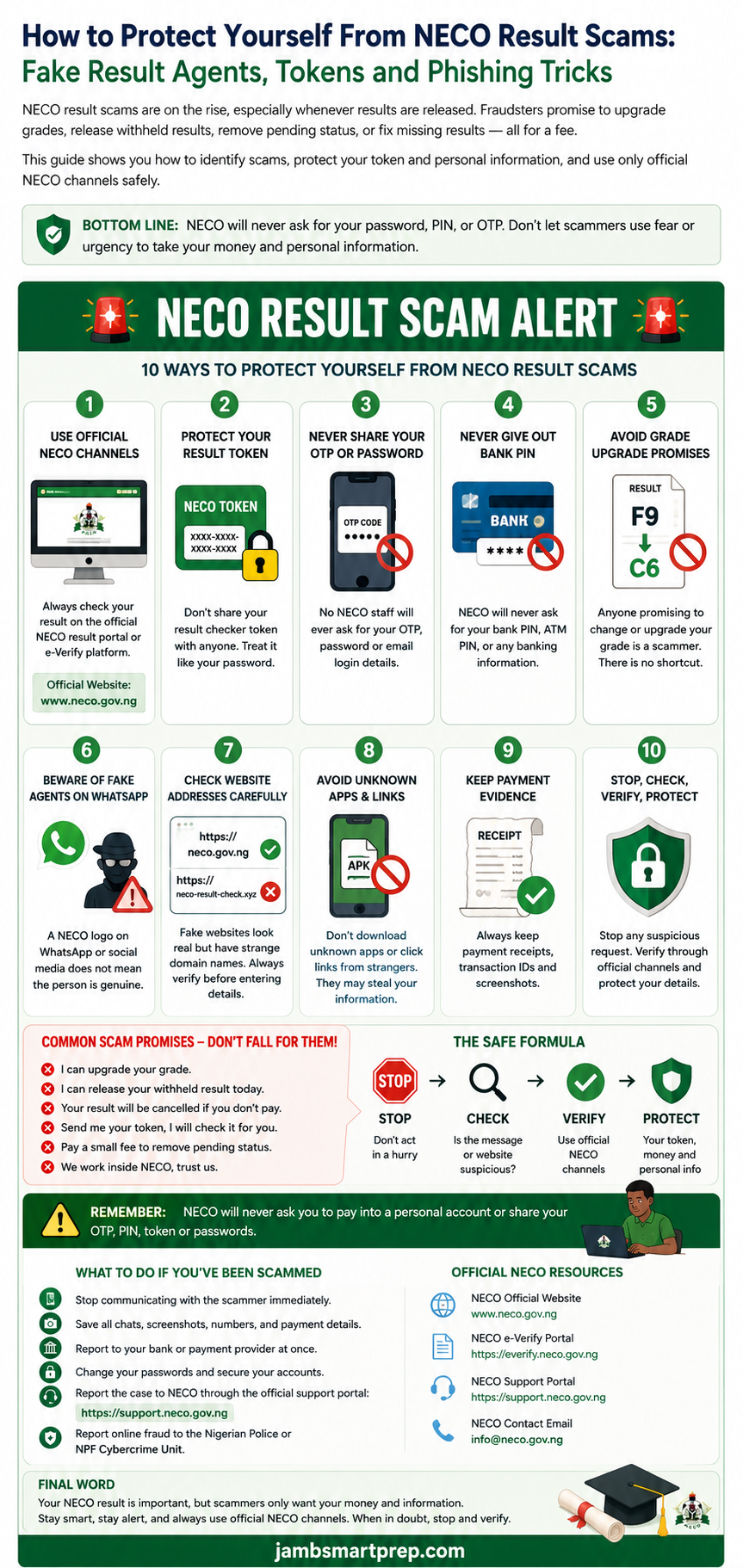
1. Use Official NECO Channels
Check results through the appropriate official service.
2. Protect Your Token
Never post your token publicly.
3. Never Share Your OTP
No result agent needs your banking OTP.
4. Never Give Your Bank PIN
Keep financial credentials private.
5. Avoid Grade Upgrade Promises
Nobody should be trusted simply because they promise to change your grade.
6. Verify WhatsApp Agents
A NECO logo does not prove that a WhatsApp account is official.
7. Check Website Addresses
Do not enter personal information on suspicious websites.
8. Avoid Unknown APK Files
Do not install an application because a stranger recommends it.
9. Save Payment Evidence
Keep receipts and transaction references.
10. Stop When Something Looks Wrong
Do not allow fear or urgency to control your decision.
What we have covered so far
Protecting yourself from a NECO result scam starts with controlling the information you give out.
Keep your result-checking token private. Never disclose your bank PIN, OTP, password or account recovery codes to someone claiming to be a NECO agent.
Be cautious with WhatsApp messages, Facebook pages, unfamiliar websites, unknown applications and anyone promising to change a grade or solve a result problem instantly.
If you have already shared sensitive information or sent money, do not continue paying in the hope that the scammer will eventually solve the problem. Preserve the evidence, secure any affected accounts, contact your financial institution when necessary and use official NECO support channels for examination-related concerns.
What to Do If You Have Been Scammed, How to Report It and NECO Scam FAQs
Even careful candidates can fall victim to an online scam. A fraudster may appear convincing, especially when the victim is worried about a NECO result that is missing, pending, withheld or incomplete.
If you have already sent money, shared a result token or disclosed personal information, do not assume that the situation cannot be fixed. The most important thing is to stop the damage from getting worse.
NECO provides official channels for examination-related support, while its e-Verify platform handles result verification and confirmation. The official NECO website currently lists its contact details and links to e-Verify.
What to Do If You Have Been Scammed Over Your NECO Result
If you realise that a supposed NECO agent has deceived you, take action as soon as possible.
1. Stop Communicating With the Scammer
Do not continue sending money because the scammer promises that one final payment will solve the problem.
A common pattern is:
“Your result is ready, but you need to pay one last fee.”
After payment, another fee appears.
If you have already identified the person as fraudulent, stop the transaction.
2. Do Not Delete the Conversation
Keep the evidence.
Save screenshots of:
- WhatsApp conversations
- SMS messages
- Facebook messages
- Telegram conversations
- Email messages
- Phone numbers
- Usernames
- Website addresses
- Payment instructions
- Bank account details
- Transaction receipts
- Promises made by the scammer
Do not edit the screenshots.
The original information may be useful when reporting the incident.
3. Contact Your Bank or Payment Provider
If you transferred money to a scammer, contact your bank or payment provider through its official customer service channel.
Explain that you believe the transaction was fraudulent.
Provide:
- Transaction reference
- Date of payment
- Amount
- Recipient account
- Recipient name
- Evidence of the conversation
- Any other information requested
Do not assume that a successful transfer means the money can never be investigated.
At the same time, do not assume that the bank can automatically reverse the transaction. The outcome depends on the circumstances and the payment system involved.
4. Secure Your Accounts
If you shared a password with the scammer, change it immediately.
If the same password was used on other accounts, change those accounts too.
Pay particular attention to:
- Banking
- Social media
- Cloud storage
- School portals
- Other accounts containing personal information
Where available, activate multi-factor authentication.
5. If You Shared an OTP, Contact Your Bank
If you disclosed an OTP connected to a bank or financial account, contact the bank using its official number or application.
Explain exactly what happened.
Do not wait for the scammer to contact you again.
If the person later claims that another OTP is needed to “reverse” the transaction, do not provide it without independently confirming the request with your bank.
6. If You Sent Your NECO Token to a Stranger
Stop sending additional information.
Check your result yourself through the appropriate official NECO service.
If you are experiencing a genuine result problem, contact NECO through its official support channel rather than allowing the person who contacted you to continue handling the matter.
NECO’s support portal provides an option to submit a ticket describing the problem and attaching relevant information.
How to Report a NECO Result Scam
There are several things you can do when you encounter a suspected NECO result scam.
Report the Examination-Related Problem to NECO
If the scam involves a claim about your actual examination record, result verification or another NECO service, use NECO’s official support system.
The support portal allows users to submit a ticket by providing their name, email, subject, description and other relevant information.
When submitting a complaint, explain the situation clearly.
For example:
“I was contacted by a person claiming to be a NECO result agent. The person requested payment to release my result and provided the following account details…”
Attach evidence where appropriate.
What Information Should You Include in a Scam Report?
A useful report should contain enough information for the receiving organisation to understand what happened.
Include:
Your details
- Full name
- Email address
- Phone number where appropriate
Scammer’s details
- Name used
- Phone number
- WhatsApp number
- Facebook profile
- Telegram username
- Website
- Email address
Transaction details
- Amount paid
- Date
- Time
- Payment method
- Transaction reference
- Recipient account information
Examination information
Only provide examination information through an appropriate official channel and avoid publishing sensitive information publicly.
You should not post your complete result token, password or financial credentials in a public complaint.
How to Report a Fake NECO Website
If you discover a website pretending to be an official NECO service, do not continue using it.
Save:
- Website address
- Screenshots
- Message that led you to the site
- Payment page
- Any confirmation message
Then report the issue through appropriate official or relevant reporting channels.
Most importantly, do not keep testing the website with your personal information.
How to Report a Fake NECO WhatsApp Account
If a person uses WhatsApp to impersonate a NECO official or advertise fraudulent result services:
- Save screenshots.
- Save the phone number.
- Save the profile information.
- Report the account through WhatsApp’s reporting function.
- Block the account.
- Report the examination-related claim to the appropriate official channel where relevant.
Do not threaten the person or attempt to recover your money through confrontation.
How to Report a Fake NECO Facebook Page
If you encounter a Facebook page claiming to represent NECO:
- Save the page address.
- Screenshot suspicious posts.
- Save the administrator’s contact information where visible.
- Report the page through Facebook.
- Notify the appropriate official examination authority if the page is impersonating NECO.
Do not send the page administrator your examination credentials simply because you want to confirm whether the page is genuine.
What If the Scammer Says They Work for NECO?
A person claiming to be a NECO employee does not automatically become an official representative.
If someone makes such a claim, verify it independently.
Do not rely on:
- Staff ID photographs
- NECO logos
- Business cards
- WhatsApp profile pictures
- Voice notes
- Screenshots
- Testimonials
The safest approach is to use official NECO contact information rather than the contact details supplied by the person.
The official NECO website currently publishes contact numbers and the email address info@neco.gov.ng.
How to Verify a NECO Result Without Using a Scam Agent
You do not need a private result agent simply because you are unfamiliar with the online process.
NECO provides official online services.
Its website links to e-Verify, which is described as an online result verification and confirmation system for individuals and institutions.
The e-Verify platform also provides a candidate login and explains its verification process, including account registration, token purchase through its payment process and submission of examination information.
This is why candidates should begin with official NECO services rather than relying on people who claim to have special access.
NECO Result Scam FAQs
Is there a genuine NECO result upgrade service?
Be extremely cautious about anyone privately offering to upgrade your examination grade.
A person who promises to change an examination grade for money is making a claim that should not be accepted simply because the person says they have contacts inside NECO.
Do not pay for an unofficial grade upgrade.
Can someone change my NECO result from F9 to C6?
Do not trust a stranger who promises to change an F9 to C6 for payment.
If you believe that your result contains an error, use the appropriate official process rather than paying an individual who promises a secret correction.
Can someone remove my withheld NECO result?
Do not pay a private individual merely because they claim they can release a withheld result.
First establish the official status of the result and follow the appropriate NECO procedure.
If you need assistance, use the official support channel.
Can someone remove a pending status from my NECO result?
A person who guarantees that they can remove a pending status for a fee should be treated cautiously.
Do not give them money or sensitive credentials without independently verifying the service.
Is it safe to send my NECO result token to an agent?
It depends on the exact official process involved, but you should not casually send a result token to an unknown person.
A token should be treated as sensitive information.
If you need help checking a result, it is safer to access the official service yourself or ask someone you trust to guide you without unnecessarily sharing the token.
Does NECO contact candidates through WhatsApp?
Do not assume that a WhatsApp account is official simply because it uses the NECO name or logo.
When you receive a message claiming to be from NECO, verify the information through the official NECO website or recognised support channel.
How do I know if a NECO result website is fake?
Look at the actual website address rather than only the logo and page design.
Be cautious about:
- Misspelled domains
- Strange web addresses
- Unsolicited links
- Unexpected payment requests
- Requests for passwords
- Requests for banking credentials
- Unknown downloads
When uncertain, open the official NECO website yourself instead of clicking a link sent by another person.
What should I do if my NECO result is not showing?
Do not immediately pay someone who claims they can recover the result.
First confirm your examination details and check the result through the appropriate official service.
If the problem remains unresolved, contact NECO support.
This is especially important because a result that is not showing may require proper investigation rather than an unofficial “fix.”
What should I do if only one NECO subject is missing?
Do not assume that the missing subject means your entire result has been cancelled.
Record exactly what is displayed and identify the affected subject.
Then use the appropriate NECO support channel if the problem persists.
Avoid anyone who immediately says:
“Send me money and I will add the subject.”
What should I do if someone asks for my NECO OTP?
Do not give it to them.
If the OTP relates to a bank or financial account, contact your financial institution through its official channel.
What should I do if I have already paid a NECO scammer?
Stop making additional payments.
Save the evidence and contact your bank or payment provider as quickly as possible.
You should also report the examination-related scam through the appropriate official channel.
Can a NECO agent ask for my bank PIN?
You should never disclose your bank PIN to someone claiming to help with an examination result.
Your bank PIN is confidential.
Can I trust a NECO agent because they have many testimonials?
No.
Testimonials can be fabricated.
Verify the service independently rather than relying on screenshots, comments or recommendations from unknown people.
Is a cheap NECO result token always genuine?
No.
Price alone does not establish authenticity.
Use the appropriate official or authorised route for purchasing the service you need.
Should I give my NECO password to someone who says they will check my result?
No.
Do not give your password to an unknown person.
If you need help, use the official service yourself or seek guidance without handing over your credentials.
NECO Result Scam Prevention Checklist
Before paying anyone or sharing information, use this checklist.
Before clicking
- Is the link from an official source?
- Did I independently verify the website?
- Is the web address correct?
Before sharing information
- Does this person genuinely need the information?
- Am I being asked for a password?
- Am I being asked for an OTP?
- Am I being asked for a bank PIN?
- Am I being asked for a result token?
Before paying
- What exactly am I paying for?
- Is the service officially documented?
- Can I verify the recipient?
- Am I being pressured?
- Is someone promising a guaranteed result change?
If something goes wrong
- Stop communicating with the scammer.
- Save the evidence.
- Contact your bank if money was sent.
- Secure compromised accounts.
- Report the fraudulent account or website.
- Contact NECO through its official support channel where the matter concerns NECO.
NECO Result Scam Prevention: The Golden Rules
If you remember nothing else from this guide, remember these rules.
Rule 1: Never pay for a secret grade upgrade
A stranger promising to change your result is a major warning sign.
Rule 2: Protect your credentials
Do not share passwords, OTPs, bank PINs or account recovery codes.
Rule 3: Verify websites independently
Do not trust a link simply because it contains the word “NECO.”
Rule 4: Do not allow urgency to control your decision
A genuine problem deserves a careful solution.
Rule 5: Keep evidence
Save messages, receipts, account details and website addresses.
Rule 6: Use official NECO channels
NECO’s official website provides access to its examination services and e-Verify platform.
Rule 7: Ask for help when unsure
A parent, guardian, teacher or trusted person may notice warning signs that you missed.
Conclusion
A NECO result scam can begin with something that looks ordinary.
You may simply be trying to check your result, understand why a subject is missing, resolve a pending status or find out what to do about a withheld result.
The danger starts when someone uses that concern to offer a secret solution.
Be particularly careful with anyone who promises to upgrade your NECO result, change your grade, release a withheld result, remove a pending status or recover a missing result in exchange for money.
Use official NECO services whenever possible. NECO’s official website currently provides access to result-related services and e-Verify, while its support portal allows users to submit support tickets when they need assistance.
NECO Official Website via https://neco.gov.ng/
NECO Support Portal via https://support.neco.gov.ng
NECO e-Verify via https://everify.neco.gov.ng/
Most importantly, slow down when somebody creates urgency around your result.
A missing result can be investigated. A pending result can be followed up. A withheld result can be addressed through the appropriate process. A suspected error can be reported.
Sending money or sensitive credentials to an unknown person can make the situation much harder to resolve.
Related NECO Guides
- NECO Result Missing or Incomplete: What to Do When Your Result Is Not Showing
- What to Do If Your NECO Result Is Still Pending
- How to Handle Withheld NECO Results
- NECO Result Cancellation: What It Means and What to Do
- NECO Result Checker Token Is Not Working
- How to Buy a Genuine NECO Result Checker Token
- NECO Result Verification Guide
- How to Correct Errors on Your NECO Result
- NECO e-Verify Portal Login: How to Verify NECO Results
- NERVS Portal: NECO Result Verification System Guide
